
Industry-Specific Software Development: A Strategic Guide for Scaleups
How to build sector-aligned systems that scale without sacrificing compliance, workflow integrity, or operational depth.
- Generic software covers roughly 60% of your needs — the remaining 40%, where real business value lives, demands sector-aligned engineering.
- Domain knowledge is not a soft skill; it directly determines whether a system solves your operational reality or merely passes code review.
- The most successful projects combine a vertical foundation for speed with custom layers that protect what makes your business competitively distinct.
- A structured Discovery phase is the most cost-effective risk mitigation available on any complex, regulated software project.
- Boutique embedded partnerships deliver senior accountability, faster decision loops, and cultural alignment without the overhead of large agency layers.
- ROI measurement should focus on operational KPIs — cycle time, exception rates, compliance incidents — not vanity infrastructure metrics.
Table of Contents
- Defining Industry-Specific Software Development
- Why General-Purpose Software Breaks in Complex Sectors
- The Role of Domain Knowledge in Engineering
- Vertical Solutions vs. Custom Software: Where to Draw the Line
- What Sector Expertise Actually Looks Like in a Partner
- A Scenario: The Cost of Skipping Domain Discovery
- Planning for Scalability and Integration
- Mitigating Risks Through Structured Discovery
- Common Mistakes Teams Make in Industry-Specific Builds
- Architectural Best Practices for Sector-Aligned Systems
- Measuring the ROI of Specialized Software Development
- Where a Boutique Partnership Model Fits In
- Mapping Business Needs to Practical Capabilities
- Balancing Technical Excellence and Industry Fluency
- Frequently Asked Questions
For today’s scaleups operating in regulated or process-heavy markets, generic software rarely solves the real problem. Off-the-shelf tools cover the obvious 60%, but the remaining 40% — the edge cases, the compliance trail, the specialized workflows — is exactly where business value lives. That’s why industry-specific software development has become a strategic priority for CEOs and CTOs who need to scale without breaking operational integrity.
In this guide, we walk through what it means to build sector-aligned systems, how to evaluate domain expertise in a partner, and how to balance speed with the depth your industry demands. Sentice works as a boutique tech partner embedded inside scaleup engineering organizations — and this is the framework we apply with every client operating in a specialized vertical.
Defining Industry-Specific Software Development
Industry-specific software development is the practice of building applications around the actual data models, workflows, terminology, and regulatory constraints of a particular sector — not adapting generic templates after the fact. Where general-purpose tools assume a flexible “one size fits most” approach, vertical systems are designed from day one for the way your industry actually operates: how approvals flow, who owns which record, what counts as an audit event, and which integrations are non-negotiable.
This is also where end-to-end software development matters. A tailored solution manages the entire lifecycle — from discovery and architecture to deployment and continuous improvement — rather than handing your team a generic shell to wrestle into shape. The result is a system that speaks your business language natively, instead of forcing your operations to bend around the software.
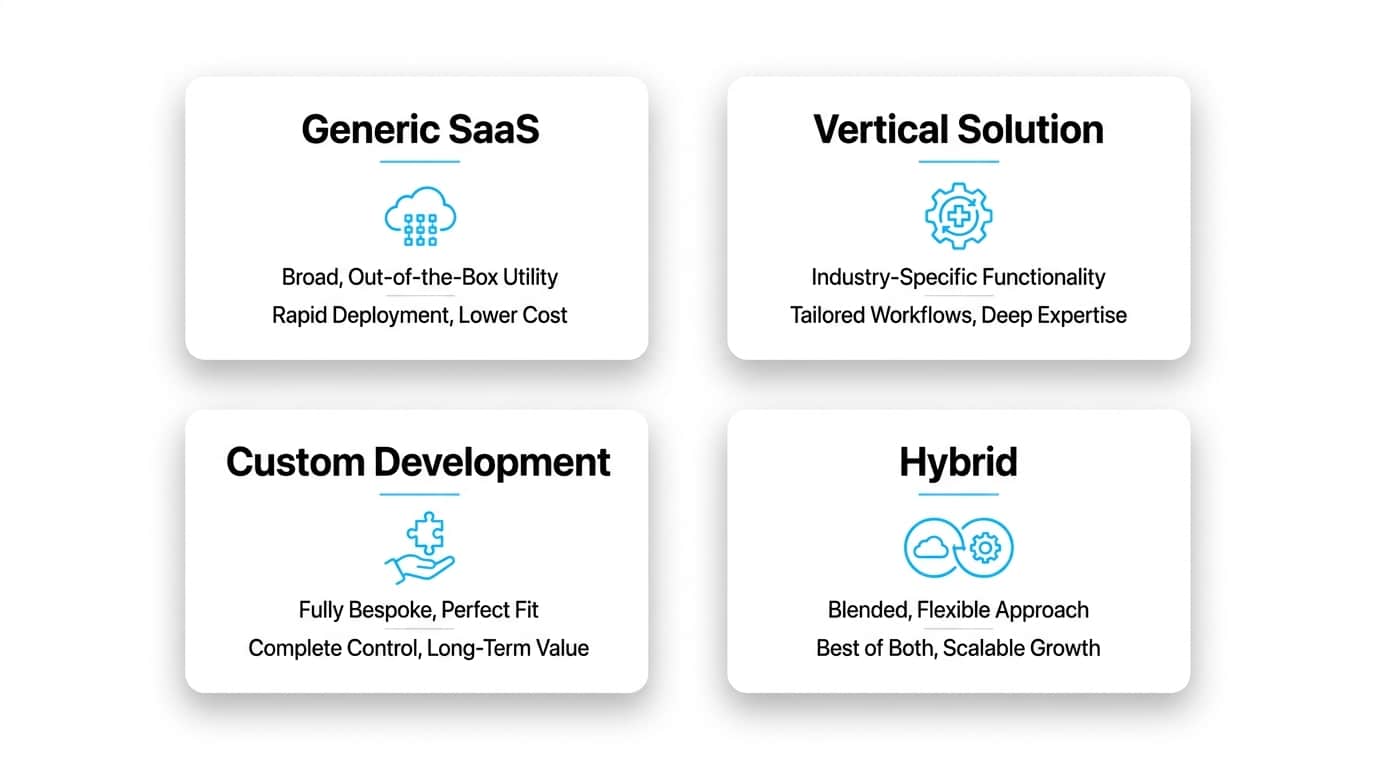
Built around the common patterns, workflows, and standards of a specific sector. Accelerates time-to-market for shared use cases.
Built from scratch around one organization’s unique competitive logic and operational requirements. Maximum fit, higher investment.
A vertical foundation paired with custom layers that protect what differentiates your business. The model most scaleups in regulated sectors use.
Why General-Purpose Software Breaks in Complex Sectors
When a generic product meets a regulated workflow, the gap usually shows up as workarounds: spreadsheets stitched onto core systems, email threads replacing approval chains, and manual reports reconciled at month-end. Each workaround introduces compliance risk, data drift, and hidden operational cost. In sectors like finance, healthcare, energy, or logistics, those gaps are not inconveniences — they are exposure.
The Bank of Israel’s financial stability reports consistently emphasize how systemic risk grows when operational tools fail to keep pace with regulatory demand. The same pattern appears across every regulated sector: the cost of maintaining workarounds compounds silently until a regulator, an audit, or an operational failure makes it visible all at once.
In regulated industries, the hidden operational cost of spreadsheet-based workarounds — reconciliation time, error correction, compliance remediation — often exceeds the cost of the software project that would have eliminated them. The “cheap” path is rarely the economical one over a three-year horizon.
The Role of Domain Knowledge in Engineering
Domain knowledge is the bridge between technical implementation and real business outcomes. Engineers fluent in your sector anticipate the bottlenecks before they appear in production: which data structures will hit performance walls, which compliance flags must trigger automatically, which user behaviors are realistic versus theoretical. Coding ability alone is not enough — without domain context, even strong engineering produces systems that miss the operational reality.
A boutique tech partner brings this dual fluency to the table: senior engineers who understand both the architecture and the business rules driving it. That’s how you avoid the costly cycle of building something technically correct but operationally wrong. When your engineering partner asks the right questions in the first discovery session — rather than the third sprint review — that’s the signal that genuine domain depth is present.
The most valuable thing a domain-fluent engineering partner brings to discovery is not answers — it’s the right questions. Early probing of compliance edge cases, integration constraints, and real user workflows prevents the architectural decisions that cost the most to reverse later.
Vertical Solutions vs. Custom Software: Where to Draw the Line
Vertical solutions are pre-built frameworks shaped around a specific sector’s common patterns — shared workflows, standard integrations, and reusable compliance modules. Custom software, in contrast, is built from scratch around your unique competitive logic. The most successful projects rarely choose one extreme. They combine a vertical foundation that accelerates time-to-market with custom layers that protect what makes your business different.
| Approach | Strength | Best Fit |
|---|---|---|
| Generic SaaS | Fast deployment, low upfront cost | Standard back-office processes |
| Vertical Solution | Industry best-practices baked in | Common sector workflows |
| Custom Development | Differentiation and exact fit | Unique competitive logic, complex compliance |
| Hybrid (Vertical + Custom) | Speed plus tailored fit | Most scaleups in regulated sectors |
Choosing where to draw this line depends on how much of your competitive differentiation lives inside the workflow itself. If your advantage is operational — proprietary approval logic, unique risk models, specialized data pipelines — that’s precisely what needs to be custom-built and protected. Everything else is a candidate for a vertical foundation that your team extends rather than reinvents.
What Sector Expertise Actually Looks Like in a Partner
When you evaluate a development partner, sector expertise should be visible in the questions they ask before the questions they answer. A team with genuine industry depth probes your edge cases, surfaces regulatory considerations early, and proposes integration strategy in the first conversation — not the third.
Key Questions to Ask During Discovery
Ask how they have handled similar data structures, what compliance frameworks they have designed against, and how they manage scope changes when regulations shift mid-project. Ask who the BA or product lead is and how they translate domain language into technical requirements. The quality of these answers tells you more about a partner’s real capabilities than any portfolio slide.
Red Flags That Signal Shallow Industry Depth
Watch for partners who treat integrations as an afterthought, cannot articulate your sector’s audit requirements, or push a fixed tech stack regardless of context. A vague answer on data governance or permission models is a leading indicator of trouble downstream. If they cannot describe what an audit event looks like in your domain before you explain it to them, they are learning on your budget.
- Raises compliance requirements unprompted in discovery
- Asks about edge cases before architectural decisions
- Proposes integration strategy in the first conversation
- Can name the regulatory framework your sector operates under
- Has a dedicated product lead who translates domain language
- Integrations treated as a post-launch concern
- Fixed tech stack pushed regardless of your context
- Vague answers on data governance or permission models
- No clear ownership of compliance scope during build
- Cannot describe audit event patterns in your sector
A Scenario: The Cost of Skipping Domain Discovery
Picture a healthtech scaleup launching a patient-facing portal. The team chose a generic CMS and a fast offshore build. Six months in, regulators flagged missing audit trails for sensitive data access — a requirement any healthcare-fluent engineer would have flagged on day one. The rebuild cost more than the original project.
This is the pattern that domain-aware development is designed to prevent: not by being cautious, but by being informed. Israel’s Privacy Protection Regulations (Information Security) make this kind of upfront design mandatory rather than optional. In regulated sectors, the question is never whether compliance needs to be designed in — it is only a matter of whether you do it at the start or pay a much higher price to retrofit it later.
Before committing to architecture, require your engineering partner to produce a compliance requirements map for your sector. This single document — covering audit events, data classification, permission models, and retention rules — should exist before a single line of production code is written.
Planning for Scalability and Integration
Future-proofing is not about predicting every requirement; it is about building systems that absorb change gracefully. That means standardized data models, well-documented APIs, and classification frameworks that align with how your industry actually exchanges information. The Israeli Central Bureau of Statistics classifications illustrate why standardized code lists matter — they are what allow disparate systems to talk to each other without constant translation overhead.
Plan integrations as first-class citizens from day one. ERP, CRM, identity providers, payment systems, document management — each connection is a contract that needs versioning, monitoring, and a fallback plan. An integration that breaks silently under load in a regulated environment is not a technical inconvenience; it is an operational and compliance event.
Mitigating Risks Through Structured Discovery
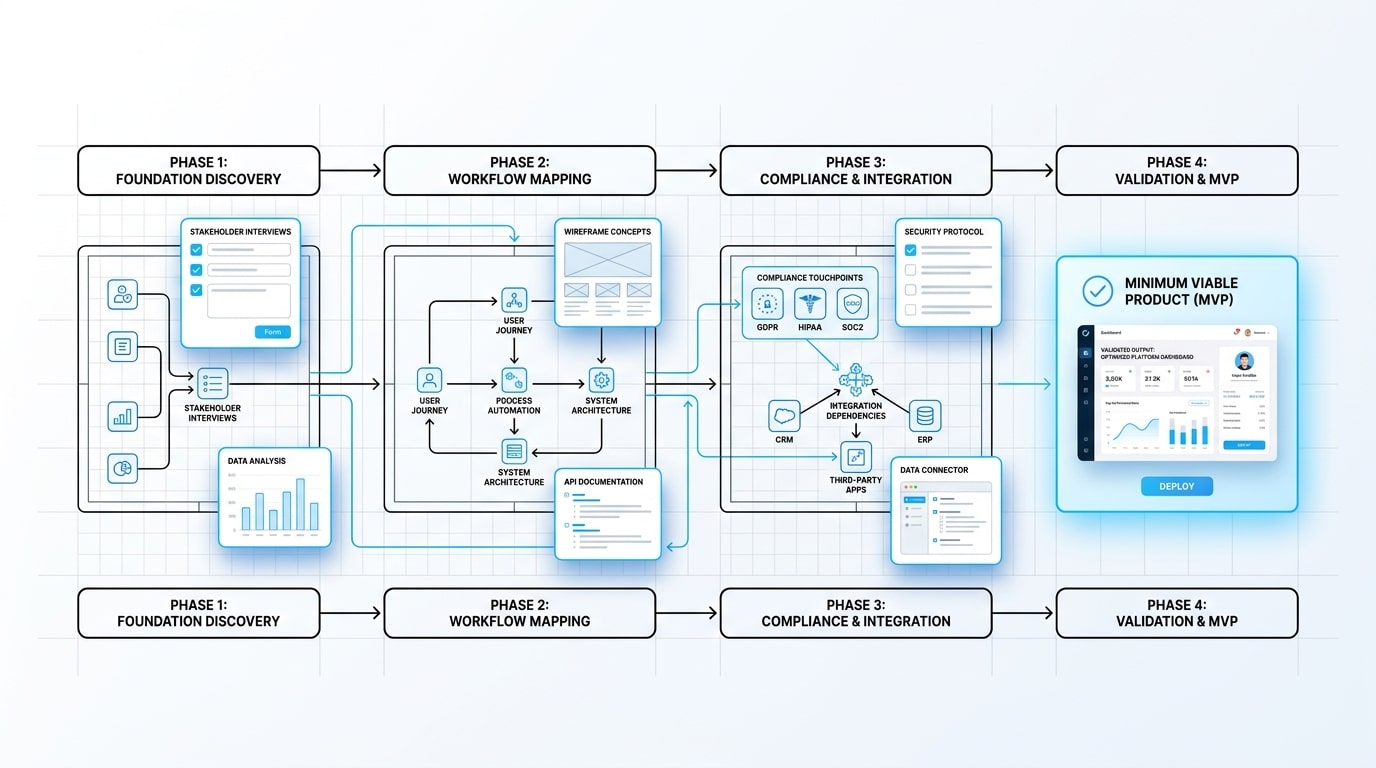
Most failed industry-specific projects do not fail because of bad code. They fail because of incomplete requirements. A structured Discovery phase systematically maps the business workflows, edge cases, regulatory touchpoints, and integration dependencies before architectural decisions are locked in. It is the most affordable insurance you can buy on a complex project — and the clearest indicator that a partner takes your domain seriously.
For many scaleups, the smartest path is targeted MVP development — building the core workflow end-to-end with full compliance and audit capabilities in place, rather than spreading thin across ten partial features. A focused MVP de-risks the project and creates a measurable foundation to expand from. It is the “start small, grow fast” philosophy applied to regulated software: learn with real data before you scale the surface area.
Common Mistakes Teams Make in Industry-Specific Builds
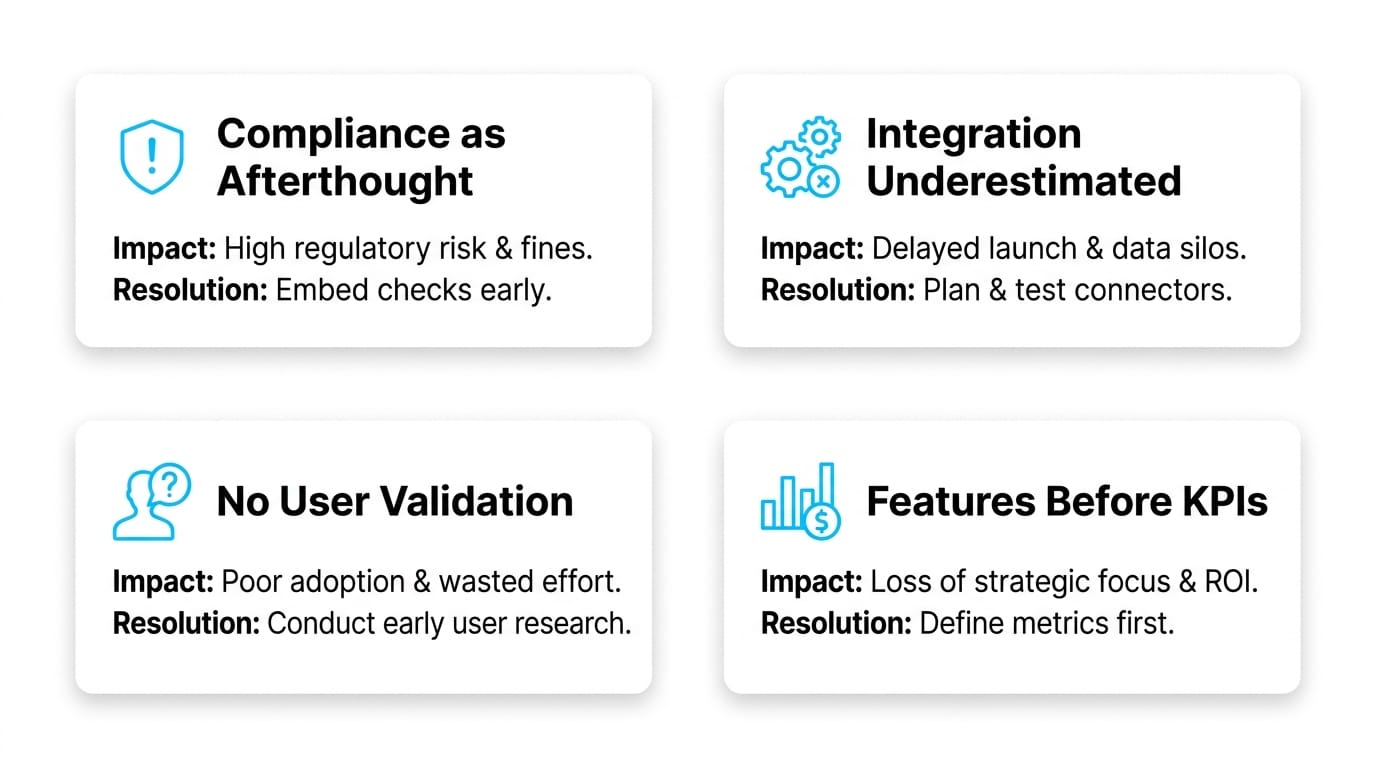
Even strong technical teams fall into a recognizable set of traps when entering a specialized domain. Recognizing them early saves months of rework and, in regulated sectors, can be the difference between a successful launch and a regulator-imposed pause.
| Mistake | Impact | How to Avoid |
|---|---|---|
| Treating compliance as a final-stage checklist | Major rework, delayed launches | Embed compliance in architecture from day one |
| Underestimating integration complexity | Schedule slip, brittle systems | Map integrations during Discovery |
| Skipping domain validation with real users | Wrong workflows shipped | Involve operational stakeholders weekly |
| Building features before defining KPIs | No clear ROI measurement | Define success metrics before scope |
Architectural Best Practices for Sector-Aligned Systems
Good architecture for industry-specific software isolates business rules from infrastructure, so regulatory changes do not trigger system-wide rewrites. Event-driven patterns help when workflows need traceability. Role-based access, structured logging, and built-in audit trails should be foundational — not features bolted on under regulator pressure.
The database notification requirements published by the Privacy Protection Authority are a clear example of why audit-readiness has to be designed in, not retrofitted. When your data model changes or a new category of personal data enters the system, the compliance obligation follows immediately — and your architecture needs to accommodate that without a crisis sprint.
Separate your business rule layer from your infrastructure layer at the design stage. When a regulator changes a rule — and in most regulated sectors, they do — your team should be able to update business logic without touching database schemas or infrastructure configuration. That separation is what makes a system genuinely maintainable at scale.
Measuring the ROI of Specialized Software Development
ROI in specialized software goes well beyond uptime metrics. The most meaningful KPIs tie directly to operational reality: cycle time per transaction, exception rates, compliance incident frequency, time-to-onboard new users, and accuracy of automated reporting. Track these from launch and you will have a defensible case for continued investment — and a clear signal of where to optimize next.
Real client success stories consistently show that deliberate product planning, with measurable KPIs defined upfront, delivers compounding returns over time. The teams that define what “success” looks like before writing a line of code are the ones who can demonstrate it to stakeholders twelve months later — and secure the budget to keep building. That discipline is as important as the engineering itself.
Where a Boutique Partnership Model Fits In
Scaleups need more than vendors — they need partners who become a genuine extension of the in-house team. A boutique partnership model offers embedded senior engineers, a dedicated product lead, and predictable delivery cadence without the overhead of large agency layers. For teams operating in Israel and beyond, this means culture-aligned collaboration, faster decision loops, and a partner that adapts to your roadmap instead of forcing you onto theirs.
That is the model Sentice is built around: tailored, end-to-end, and aligned with your business outcomes. We do not hand you a team and step back — we integrate with your product organization, participate in your planning cycles, and take ownership of delivery as if your roadmap were our own. Building tomorrow’s solutions, together is not a tagline; it describes how the engagement actually works.
Mapping Business Needs to Practical Capabilities
To make the abstract concrete, here is how common scaleup challenges map to what an embedded partnership model actually delivers in day-to-day work.
| Business Need | How a Boutique Tech Partner Helps |
|---|---|
| Scaling engineering capacity quickly | Embedded senior team, ramp-up in weeks rather than months |
| Navigating regulated workflows | Domain-aware engineers who design for compliance from day one |
| Maintaining product quality at speed | Full SDLC ownership with structured Discovery and QA |
| Predictable budget and timeline | Transparent engagement models aligned to milestones |
| Cultural and timezone alignment | Israel-based boutique team integrated with your stakeholders |
Balancing Technical Excellence and Industry Fluency
The highest-value projects sit at the intersection of strong engineering and deep sector understanding. Choose a partner who can write production-grade code and explain why a particular workflow matters to your compliance officer. That dual fluency is what separates software that ships from software that actually transforms operations.
This balance is harder to find than either skill in isolation. Strong generalist engineers are abundant. Deep domain experts who cannot build are equally common. The boutique embedded model is specifically designed to keep both in the same room — senior engineers who have worked in your sector, led by a product lead who can translate between your business stakeholders and the technical team without losing fidelity in either direction.
When assessing a potential engineering partner, ask them to walk through one compliance scenario relevant to your sector — unprompted. How quickly they surface the right edge cases, and how fluently they connect those cases to architectural choices, tells you everything about whether their domain knowledge is genuine or rehearsed.
Frequently Asked Questions
What is industry-specific software development?
It is the process of building software around the workflows, data models, terminology, and regulations of a specific sector, rather than adapting generic tools after the fact. The defining characteristic is that the system is designed from day one to reflect how your industry actually operates — approvals, audit trails, integration contracts, and all — rather than being retrofitted to fit a generic template.
How is industry-specific software different from custom software?
Custom software is built for one organization’s unique needs from scratch. Industry-specific (vertical) software is built around patterns common to a whole sector — shared workflows, regulatory frameworks, and standard integrations. Most successful projects combine both: a vertical foundation that accelerates delivery, with custom layers that protect your specific competitive logic.
How long does an industry-specific project typically take?
Timelines depend on integration complexity, compliance scope, and the maturity of your existing requirements. A focused MVP covering one core workflow end-to-end — with full audit and security capabilities in place — often reaches production in a few months. Full platform builds with multiple integrations and compliance frameworks typically extend over a year or more. A structured Discovery phase gives you a realistic timeline before architectural decisions are locked in.
How do I evaluate domain expertise in a development partner?
Ask for examples of similar data structures they have worked with, request an introduction to their product or BA lead, and observe how early they raise integration and compliance considerations during initial conversations. A partner with genuine domain depth will surface sector-specific edge cases and regulatory constraints without being prompted — that proactive fluency is the clearest signal of real expertise.
Should we start with an MVP or build the full system?
For most scaleups, a focused MVP that covers one core workflow end-to-end — including audit capability and security controls — is the lower-risk path. It lets your team validate real operational behavior with real data before expanding scope. Spreading across ten partial features in the first release is one of the most common causes of costly rework in regulated-sector projects.
How do we measure ROI on a specialized software project?
Track operational KPIs defined before scope is set: cycle time per transaction, exception rates, compliance incident frequency, time-to-onboard new users, and accuracy of automated reporting. Tie each metric to the business outcome it supports. Teams that establish these baselines before launch are the ones who can demonstrate compounding returns twelve and twenty-four months after go-live.
What is the advantage of a boutique partner over a large agency?
Boutique partners offer senior, embedded teams with direct accountability, faster decision-making, and a closer cultural fit. You work with the engineers building your product — not a rotating cast of junior staff managed through overhead layers. For scaleups that need to move quickly without sacrificing quality or compliance, that directness is often the decisive factor in choosing a partner.

Sentice is a boutique tech partner that builds custom software solutions for startups and scaleups. We embed senior engineers into your product organization as a real extension of your team — culture-aligned, end-to-end, and committed to your roadmap.