

Dedicated Software Development Team: The Complete Guide for Startups and Scaleups
Everything you need to know to choose, structure, and lead an embedded engineering team that grows with your product.
- A dedicated software development team works exclusively on your product, preserving domain knowledge and delivering predictable velocity over the long term.
- The model suits companies with evolving roadmaps — it absorbs change without renegotiating contracts, unlike fixed-price engagements.
- Ramp-up typically takes two to six weeks, significantly faster than internal hiring, which can stretch to three to six months.
- DORA metrics — deployment frequency, lead time, change failure rate, and time to restore — are the most reliable way to measure team health objectively.
- True exclusivity, clear IP ownership, and embedded QA from day one are non-negotiable requirements when evaluating vendors.
- Cultural alignment and shared engineering standards matter as much as technical skill — a culture-aligned team becomes a genuine extension of your organization.
Table of Contents
- What is a dedicated software development team?
- Why companies choose a dedicated team over internal hiring
- Who is the dedicated team model best suited for?
- When a dedicated software development team is not the right choice
- Dedicated team vs. staff augmentation: a clear comparison
- Dedicated team vs. fixed price: choosing the right model
- What defines an exclusive dev team?
- Which roles are essential in a dedicated software development team?
- How does the onboarding and ramp-up process work?
- How long does it take to establish a dedicated team?
- What are the costs of hiring a dedicated software development team?
- Remote management: how to lead a dedicated team without losing control
- How to measure success and productivity in a dedicated team
- How quality and test automation are ensured in a dedicated team
- Protecting intellectual property and data security
- Dedicated team vs. working with freelancers
- Scaling a dedicated team: when and how?
- How to select a vendor for a dedicated software development team
- Can a dedicated team work on existing code?
- What does “committed developers” really look like?
- Resolving conflicts within a dedicated remote team
- Frequently asked questions
For today’s startups and scaleups, building software at speed without sacrificing quality has become the defining challenge of growth. Internal hiring takes months, freelancers create knowledge gaps, and rigid outsourcing rarely matches the pace of evolving product roadmaps. This is where a dedicated software development team changes the equation — providing an embedded, culture-aligned unit that works exclusively on your product, owns delivery end-to-end, and grows with your business.
In this guide, you will learn what this model truly means in practice, when to choose it, how to evaluate vendors, and how to measure success once your team is up and running. Throughout, you will find practical frameworks and real benchmarks — including DORA metrics and ramp-up timelines — to help you make confident decisions. Sentice works with startups and scaleups as a boutique tech partner, embedding senior engineers directly into your product organization to accelerate exactly this kind of growth.
What is a dedicated software development team?
A dedicated software development team is a long-term collaboration model where a group of engineers, QA specialists, and tech leads works exclusively on your product. Unlike short-term outsourcing, this model emphasizes domain knowledge retention, predictable velocity, and a true partnership mindset. Your team becomes an extension of your internal organization — aligned with your goals, your culture, and your roadmap.
Every hour the team works is dedicated to your product alone. No context switching, no shared focus, no competing client priorities pulling at your engineers’ attention.
The team builds deep familiarity with your architecture, your users, and your business logic — institutional knowledge that compounds in value over time.
Engineers treat your product as their own, proactively proposing improvements and taking ownership of outcomes rather than just completing assigned tasks.
Understanding “dedicated” in practice
“Dedicated” means exclusivity, full-time availability, and seamless integration into your internal culture. The team participates in your ceremonies, follows your engineering standards, and treats your product as their own. There is no context switching between clients and no shared focus. When an engineer finishes their day, your product is the only thing they have been thinking about.
Dedicated team vs. ad-hoc outsourcing
Ad-hoc outsourcing closes specific tasks and disappears. A dedicated team builds institutional memory, owns architectural decisions, and stays accountable for long-term outcomes — which is critical for products that continue to evolve. The difference in output quality compounds over months, not sprints.
Why companies choose a dedicated team over internal hiring
Internal hiring is slow, expensive, and risky. A dedicated model lets you scale capacity in weeks, not quarters, while reducing HR overhead. You skip the recruitment funnel, the onboarding ramp, and the uncertainty of single-hire bets — and gain a complete squad ready to deliver. For companies operating in fast-moving markets, the time advantage alone often justifies the model.
A typical senior engineering hire takes three to six months from job posting to productive contribution. A pre-vetted dedicated team can be onboarded and delivering in two to four weeks — a difference that translates directly into earlier revenue and faster product validation.
Speed to market and recruitment efficiency
Skipping the traditional hiring funnel means starting development weeks earlier. For products competing on time-to-market, those weeks translate directly into revenue, user feedback cycles, and competitive positioning. Your team arrives with the technical stack already in place, removing the ramp-up curve entirely.
Scalability for roadmap requirements
You can grow or shrink the squad as your roadmap shifts — adding a backend engineer for a new module, or a QA automation specialist before a major release. This elasticity is impossible with permanent headcount, where every addition involves months of process and every reduction carries significant cost and cultural weight.
Who is the dedicated team model best suited for?
The model fits companies with continuous product development, evolving requirements, and a desire to build long-term capability rather than chase short-term deliverables. If your product lives and grows over years, you need a team that grows with it. The two most common profiles are early-stage startups and enterprises managing modernization programs.
Startups: from MVP to scale
Early-stage founders use a lean dedicated squad to validate an idea, then scale the same team into a full engineering organization once product-market fit is reached — preserving every line of context. This continuity is invaluable: the engineers who built your first feature understand exactly why architectural decisions were made and how the codebase has evolved.
Enterprises: modernization and migration
Large organizations leverage dedicated teams to modernize legacy platforms, run cloud migrations, or build new digital products without distracting their core internal staff. A dedicated squad can operate as an autonomous innovation unit — moving faster than internal bureaucracy while remaining fully aligned with enterprise standards and security requirements.
When a dedicated software development team is not the right choice

If your project has a tightly fixed scope, a hard deadline, and zero expected change — a fixed-price engagement may serve you better. Similarly, if no internal product owner is available to prioritize work, a dedicated team will idle waiting for decisions. The model depends on active collaboration from your side; it is not a set-and-forget arrangement.
Research consistently shows that the leading cause of outsourced team failure is not technical skill gaps — it is insufficient product ownership on the client side. A dedicated team amplifies your decision-making capacity; it cannot replace it.
Warning signs for project fit
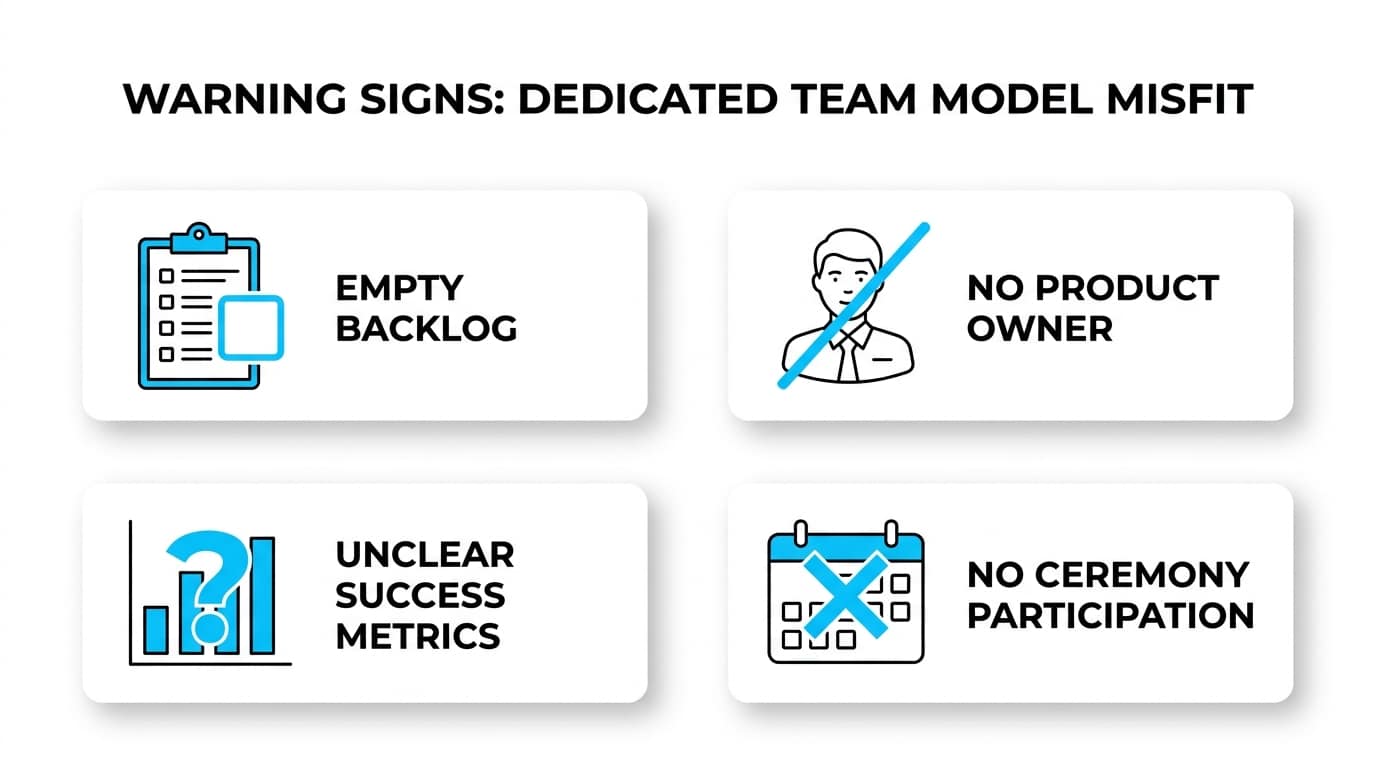
An empty backlog, no defined product owner, unclear success metrics, or unwillingness to participate in regular ceremonies are all signals to pause and reconsider the engagement model before committing. Taking time to align on these fundamentals before signing a contract saves significant cost and frustration on both sides.
Dedicated team vs. staff augmentation: a clear comparison
Staff augmentation places individual specialists into your existing process. A dedicated team delivers an autonomous unit with its own leadership, QA practice, and delivery rhythm. The difference is between renting hands and gaining a partner. Understanding this distinction is essential before you commit budget and time to either model.
| Criterion | Dedicated Team | Staff Augmentation | Fixed Price |
|---|---|---|---|
| Scope flexibility | High | High | Low |
| Management overhead | Low | High | Medium |
| Knowledge retention | Strong | Weak | Limited |
| Best for | Evolving products | Skill gaps | Fixed deliverables |
| Quality ownership | Team-owned | Client-owned | Vendor-owned |
Autonomy, integration, and management responsibility
A dedicated team handles end-to-end delivery — planning, coding, testing, deployment, and monitoring — significantly reducing the management burden on your side. You retain strategic direction while the team owns execution. Staff augmentation, by contrast, requires your internal leads to coordinate, direct, and quality-check every individual resource.
Knowledge continuity during turnover
If a single contractor leaves, their knowledge leaves with them. A dedicated team maintains shared documentation, code reviews, and pairing practices that preserve institutional knowledge even through rotation. This structural resilience is one of the strongest long-term arguments for the dedicated model over individual augmentation.
Dedicated team vs. fixed price: choosing the right model
Fixed price assumes you can predict every requirement upfront. The dedicated model assumes — realistically — that priorities will shift. You pay for capacity and time, not for a frozen scope document. For most modern digital products, where user feedback continuously reshapes the roadmap, a capacity-based model is the more honest and ultimately more cost-effective approach.
Aligning the model with project uncertainty
The higher the uncertainty in your roadmap, the more value you get from a capacity-based model that absorbs change without renegotiating contracts. A fixed-price engagement that requires three change orders in the first month is more expensive and slower than a dedicated team that simply reprioritizes the backlog in the next sprint planning session.
Long-term impact on code quality and technical debt
Stable team composition reduces technical debt accumulation. Empirical research on developer roles confirms that consistent core contributors produce more maintainable systems over time — a finding detailed in this empirical study on developer roles and stability. Fixed-price engagements, by optimizing for delivery speed within a budget, frequently externalize quality costs onto the next engagement.
What defines an exclusive dev team?
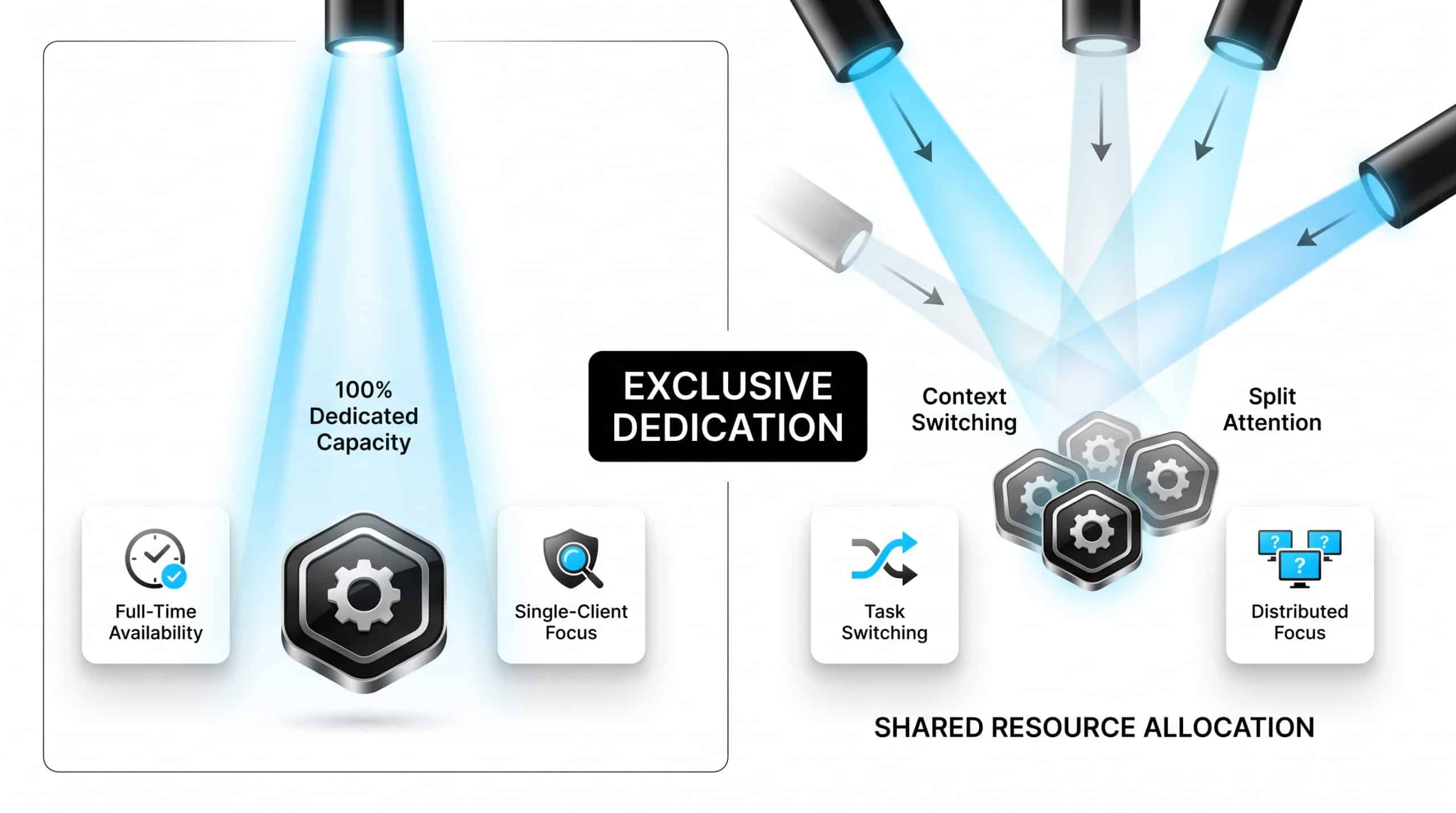
An exclusive dev team is allocated solely to you — no shared resources, no parallel clients pulling at attention. Non-exclusive arrangements often suffer from context switching, priority conflicts, and unpredictable response times. True exclusivity is a contractual and operational commitment, not just a sales promise, and it needs to be verified throughout the engagement.
- Named team members in the contract
- Capacity reports showing 100% allocation
- Access to team calendars and standups
- Direct communication channels with all engineers
- Regular sprint reviews with full team attendance
- Inconsistent sprint velocity week over week
- Delayed responses outside core hours
- Vague answers about engineer availability
- Engineers missing standups without explanation
- Sudden drops in throughput with no clear cause
Ensuring true exclusivity
Confirm exclusivity in the contract, request named team members, and verify that capacity reports reflect 100% of working hours assigned to your project. A reputable partner will have no hesitation providing this transparency — if they do hesitate, treat it as a serious signal.
Indicators of hidden resource sharing
Watch for inconsistent response times, fluctuating sprint velocity, or vague answers about team availability — these often signal that resources are split behind the scenes. Establishing a regular cadence of sprint reviews and capacity check-ins from the very first week creates the accountability structure that prevents this.
Which roles are essential in a dedicated software development team?
The minimum effective composition includes developers, QA engineers, and a tech lead. Depending on complexity, you may add a delivery manager, DevOps engineer, or designer. The right mix depends on product maturity and risk profile — over-staffing early creates coordination overhead; under-staffing creates bottlenecks that slow the whole squad.
Two to three full-stack developers, a part-time QA, and a tech lead are usually enough to validate an idea and ship a first version with enough quality to gather real user feedback.
Dedicated QA, frontend and backend specialists, and a delivery manager to maintain release cadence as the product scales and the team handles more parallel workstreams.
Full DevOps and SRE coverage alongside core engineering, supporting continuous deployments, observability requirements, and strict uptime SLAs in a live production environment.
Lean squad for an MVP
Two to three full-stack developers, a part-time QA, and a tech lead are usually enough to validate an idea and ship a first version. Keeping the squad lean at this stage accelerates decision-making and ensures everyone retains full context across the entire codebase.
Full squad for mature products
A production-ready product needs dedicated QA, DevOps, frontend and backend specialists, and clear delivery management to maintain release cadence. Role specialization at this stage reduces the cognitive load on individual engineers and improves the reliability of each release.
When to include DevOps and SRE
Once you have continuous deployments, observability needs, or strict uptime SLAs, embedded DevOps and SRE roles become essential rather than optional. Treating infrastructure and reliability as afterthoughts at this stage creates compounding operational risk that is expensive to unwind.
How does the onboarding and ramp-up process work?
A structured onboarding integrates the team into your ecosystem quickly. The first two weeks define the next two years — clear goals, documented standards, and access to the right people make the difference between a slow start and immediate momentum. Treating onboarding as a genuine investment, not an administrative checkbox, consistently produces faster delivery and fewer early-stage rework cycles.
Repository access, environment setup, architecture walkthroughs, introductions to product stakeholders, and a documented Definition of Done should all be completed by the end of day five. Any item left open beyond week one creates a compounding drag on velocity.
Goal setting, KPIs, and Definition of Done
Define what success looks like before writing a single line of code: business KPIs, technical KPIs, and a shared Definition of Done. Without this shared foundation, teams optimize for different things and delivery quality becomes inconsistent across sprints.
Skills and seniority matching
Match team profiles to actual workload — not every role needs a senior, and over-staffing seniors can slow decision-making as strong opinions compete for direction. A healthy squad typically mixes senior leadership with mid-level executors who are fast, focused, and eager to grow.
Technical and cultural onboarding
Repository access, environment setup, architecture walkthroughs, and introductions to product stakeholders should all happen in week one. Cultural onboarding — understanding your communication norms, decision-making processes, and values — matters equally and is often overlooked entirely.
How long does it take to establish a dedicated team?
Typical ramp-up runs from two to six weeks, depending on seniority, tech stack rarity, and your availability for interviews. Common stacks fill faster; specialized profiles like ML engineers or security architects take longer. Planning for this window realistically — rather than expecting an overnight start — results in better hiring decisions and fewer early-stage mis-hires.
Factors that accelerate or delay ramp-up
Clear job descriptions, fast interview turnaround, and pre-built squad templates accelerate setup significantly. Vague requirements, slow feedback loops, and multiple rounds of interviews for every role are the most common causes of delays. Committing a product or engineering lead to the interview process for two to three hours per week makes an outsized difference to overall timeline.
Phased start for delivery momentum
Start with a core pair while the rest of the team is being assembled. This delivers early wins, tests collaboration patterns before scaling up, and gives the first engineers time to build domain context that they can then transfer to teammates joining later. The “start small, grow fast” approach consistently outperforms waiting for a full squad before beginning.
What are the costs of hiring a dedicated software development team?
Costs depend on team size, seniority, tech stack, and engagement geography. The smarter comparison is total cost of ownership — including management time, quality outcomes, and retention — rather than hourly rate alone. A team with a higher monthly rate that requires minimal management and ships clean code is almost always less expensive in practice than a cheaper team that generates rework and demands constant oversight.
Calculating costs by role and seniority
Build a monthly budget per role rather than per project. This makes scaling decisions transparent and predictable, and it aligns your spending with actual capacity rather than estimated deliverables that rarely match reality. Typical roles to budget for include tech lead, senior developer, mid-level developer, QA engineer, and delivery manager.
Hidden operational costs
Communication overhead, leadership time spent on direction-setting, and rework from poor quality are real costs that cheap hourly rates often obscure. Factor in the time your own team spends managing the engagement — every hour a CTO or product manager spends on coordination is an hour not spent on strategy.
Structuring budgets around milestones
Tie budgets to product milestones and release cycles — not to calendar quarters — so spending aligns with business value creation. This also makes it easier to justify the investment to stakeholders who want to see clear outcomes tied to each phase of spend.
Remote management: how to lead a dedicated team without losing control
Effective remote leadership focuses on outcomes, not hours. Establish clear product ownership, agile ceremonies, and transparent reporting — then trust the team to deliver. Working with a partner that provides end-to-end software development simplifies remote management because full-cycle responsibility eliminates handoff gaps and accountability gray areas that erode trust in distributed settings.
Agile ceremonies and rituals
Sprint planning, daily standups, reviews, and retrospectives keep distributed teams aligned. The principles outlined in the Agile Manifesto remain a strong foundation for these rituals. Consistency matters more than perfection — a team that holds the same ceremonies every sprint, even imperfectly, outperforms one that skips them when things get busy.
Documenting knowledge to prevent silos
Decisions, architecture rationale, and onboarding flows should live in shared documentation — not in someone’s head. This protects continuity even through team rotation and ensures that new members can get up to speed without requiring dedicated knowledge-transfer sessions that drain senior engineers’ time.
SLAs for communication and availability
Define overlap hours, response time expectations, and escalation paths. Predictability beats availability theater every time — a team that responds within two hours during defined windows is far more productive than one that claims to be always available but actually responds inconsistently throughout the day.
How to measure success and productivity in a dedicated team
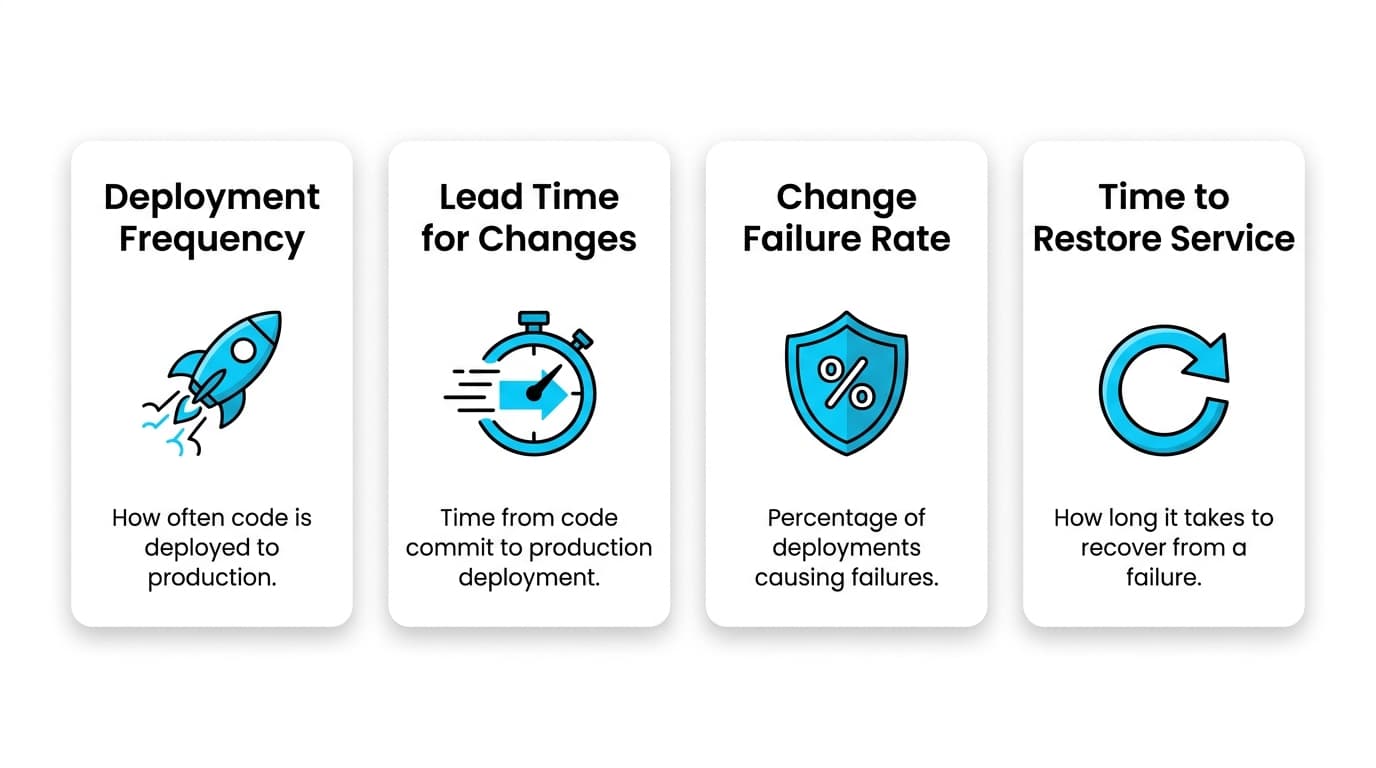
Velocity alone is misleading. The strongest teams measure delivery, quality, and stability together using DORA metrics, which provide an industry-standard view of operational health. The full framework is detailed in the 2022 Accelerate State of DevOps Report and gives engineering leaders a shared vocabulary for discussing team performance with confidence.
| DORA Metric | What it measures | Why it matters |
|---|---|---|
| Deployment Frequency | How often code reaches production | Indicates delivery throughput |
| Lead Time for Changes | Time from commit to production | Reveals process efficiency |
| Change Failure Rate | % of deployments causing issues | Signals quality discipline |
| Time to Restore Service | Recovery speed after incidents | Reflects operational resilience |
Delivery metrics
Deployment frequency and lead time for changes show how fast your team can move ideas into production. Elite teams as defined by the DORA research deploy multiple times per day with lead times measured in hours — a benchmark that is achievable with mature CI/CD practices and strong test coverage.
Quality metrics
Change failure rate and escaped defect rate reveal whether speed is coming at the cost of stability. A team shipping frequently but with a high change failure rate is not actually performing well — it is compressing future rework costs into the present release cycle.
Velocity and predictability
Predictable sprint outcomes matter more than raw velocity numbers — they indicate a mature team with reliable estimation. A team that consistently delivers 80% of what it commits to is more valuable than one that occasionally delivers 120% and frequently delivers 40%.
How quality and test automation are ensured in a dedicated team
Quality is built in, not bolted on. A strong dedicated team integrates QA into every sprint — with unit tests, integration tests, code reviews, and automated CI/CD pipelines. This approach is especially critical during MVP development, where shortcuts taken early become technical debt that compounds for years and ultimately slows the team that inherits the codebase.
Establishing a Definition of Done
A shared Definition of Done removes ambiguity about what “finished” really means and prevents quality regression across sprints. Every story should meet the same quality bar — code reviewed, tests written, documentation updated, and acceptance criteria verified — before it is considered complete.
Integrating automated testing in CI/CD
Every pull request should trigger automated tests. This catches regressions early, keeps your main branch always shippable, and removes the need for manual regression cycles that delay releases. Investing in test infrastructure early pays dividends across every sprint for the life of the product.
Protecting intellectual property and data security
Working with an external team requires clear contracts, secure development practices, and verifiable standards. Established frameworks like the NIST Secure Software Development Framework (SSDF) provide a solid baseline for IP protection, secure coding, and supply chain security. Selecting a partner committed to technical excellence ensures these standards are applied consistently across every phase of the engagement, not just at contract signing.
All code, designs, documentation, and derivative works should be explicitly assigned to your company. Include clauses covering work-for-hire, confidentiality, non-compete for the engagement period, and data processing agreements aligned to your jurisdiction’s privacy requirements.
Dedicated team vs. working with freelancers
Freelancers can be cost-effective for isolated tasks but introduce significant overhead in coordination, quality assurance, and continuity. Managing five freelancers requires five onboarding processes, five quality checks, and five relationship investments — and when any one of them is unavailable, a critical path stalls. A dedicated team consolidates this complexity into a single managed unit — one point of accountability, one delivery rhythm, one culture. For any product that spans multiple months or multiple workstreams, the coordination cost of freelancers quickly exceeds the cost premium of a dedicated team.
Scaling a dedicated team: when and how?
Scale when bottlenecks become systemic — your backlog is growing faster than throughput, QA cycles are delaying releases, or DevOps tasks are routinely blocking developers. Add specialists incrementally and always validate that team velocity actually rises after scaling. Adding people to a team that lacks clear processes or a healthy codebase can reduce velocity before it improves it, as coordination overhead temporarily outweighs added capacity.
If your lead time for changes has been increasing for three consecutive sprints and the backlog is growing rather than shrinking, that is a reliable signal that capacity needs to expand. Waiting longer turns a manageable scaling event into an emergency hire with the quality trade-offs that come with it.
How to select a vendor for a dedicated software development team
Evaluate technical competence, domain experience, cultural fit, and proven track record with similar products. Ask for references, sample architectures, and clear answers about exclusivity, retention, and security practices. The vendor’s willingness to answer hard questions transparently is itself a strong signal about the kind of partner they will be in practice.
| Business Need | How a boutique partner helps in practice |
|---|---|
| Speed to market | Pre-vetted senior engineers ready to start within weeks |
| Predictable quality | Embedded QA and CI/CD practices from day one |
| Cultural alignment | Partnership with overlapping work hours and shared business mindset |
| Scalable capacity | Flexible squad expansion tied to roadmap milestones |
| End-to-end ownership | Full SDLC coverage from discovery to production support |
Can a dedicated team work on existing code?
Yes — but it requires a structured knowledge transfer phase. A good team audits existing technical debt, documents the current architecture, and proposes a phased improvement plan before introducing major changes. This protects your product from disruption during the handover and gives the incoming team the context they need to make sound decisions rather than inadvertently repeating past mistakes. Expect the first two to four weeks to be investment rather than output — the return comes in the form of faster, safer delivery from week six onwards.
What does “committed developers” really look like?
Commitment shows up as psychological ownership — engineers who debate architectural decisions, propose improvements unprompted, flag risks before they become incidents, and take genuine pride in product outcomes. You can see it in code review comments that go beyond syntax, in backlog refinement sessions where the team pushes back on low-value work, and in retrospectives where problems are surfaced honestly rather than glossed over. High retention within the squad is the strongest external signal of genuine commitment — engineers who stay on your product for twelve, eighteen, or twenty-four months accumulate an understanding of your business that is genuinely difficult to replace.
Resolving conflicts within a dedicated remote team
Distance amplifies small misalignments. A disagreement that would be resolved in five minutes at a whiteboard can fester for days across asynchronous communication channels. Address tensions early through one-on-ones, retrospectives, and clear escalation paths. Strong delivery managers detect friction before it impacts velocity — not through surveillance, but through the kind of relational investment that surfaces problems when they are still small. Culture-aligned partners actively invest in team health rather than waiting for issues to surface in missed sprint commitments or unexpected resignations.
Frequently asked questions
How long is a typical contract for a dedicated team?
Most engagements run for six to twelve months minimum, with monthly rolling renewals after the initial term. Longer commitments often unlock better team stability and pricing, because the vendor can invest more confidently in the match between team profile and your product requirements. Short-term engagements below three months rarely allow enough time for the team to reach full productive velocity.
Can I interview and select team members myself?
Yes. Reputable partners present candidates with full transparency and let you participate in technical interviews before approval. This is not just a right — it is a practice you should insist on. Engineers you have met and evaluated are far more likely to feel like a true extension of your team than those who arrive as anonymous resources assigned by the vendor.
What happens if a team member underperforms?
A reputable vendor replaces them at no cost to you, with structured knowledge transfer to maintain continuity. The replacement process should be documented in your contract, including the timeline for finding a replacement and the expectations for overlap to protect institutional knowledge during the transition.
Is there a trial period?
Many engagements include a 30 to 60-day evaluation window to validate fit before long-term commitment. Use this period actively — run full sprint cycles, review code quality, assess communication patterns, and evaluate how the team handles ambiguity. The trial period is as much an opportunity for the vendor to prove their value as it is for you to validate the relationship.
Can I scale the team up or down mid-engagement?
Yes. Capacity adjustments are typically possible with 30 days’ notice, aligned to your roadmap needs. Some vendors offer faster scaling for growth and require slightly longer notice for reductions due to the employment obligations involved. Clarify these terms before signing so that scaling decisions remain predictable and budget-aligned throughout the engagement.
Who owns the intellectual property?
You do — fully and exclusively. Contracts should explicitly assign all code, designs, and documentation to your company. Review the IP assignment clauses carefully with your legal counsel before signing, paying particular attention to work-for-hire provisions, open-source component policies, and any carve-outs the vendor may have included for pre-existing tools or libraries.
How is communication handled across time zones?
Defined overlap hours, asynchronous documentation, and clear SLAs ensure smooth collaboration regardless of geography. The most effective distributed teams establish a two to four hour daily overlap window for synchronous ceremonies and decision-making, and use asynchronous tools — documented ADRs, written sprint summaries, recorded walkthroughs — to fill the gaps. Predictable communication rhythms consistently outperform ad-hoc availability claims.

Sentice is a boutique tech partner that builds custom software solutions for startups and scaleups. We embed senior engineers into your product organization as a real extension of your team — culture-aligned, end-to-end, and committed to your roadmap.