
How to Work with a Technology Partner: The Complete Guide for Scaleups
A practical, end-to-end framework for building, managing, and scaling a technology partnership that accelerates your roadmap without compromising quality.
- A true technology partner shares accountability for business outcomes, not just ticket delivery — they shape your roadmap alongside you.
- The three internal roles you must have in place are Product Owner, Technical Lead, and Business Stakeholder; missing any one stalls decisions.
- Scope is best defined through outcome-based MVP milestones in two-to-four-week slices, not exhaustive upfront specifications.
- Pricing model selection should match your level of certainty: fixed price for stable scope, dedicated team for long-term embedded partnerships.
- DORA-style metrics — lead time, deployment frequency, change failure rate, and MTTR — give you a balanced view of speed and stability.
- Exit and knowledge-transfer terms must be agreed before signing; they protect the partnership as much as they protect your codebase.
Table of Contents
- Understanding What a Technology Partner Really Is
- How Is a Technology Partner Different from a Vendor?
- Laying the Foundation Before the First Line of Code
- Defining Scope Without Building a 200-Page Specification
- Which Internal Roles Must You Have in Place?
- Building a Development Collaboration Framework
- Mastering Communication and Expectation Management
- How Do You Choose a Partner Who Actually Fits?
- Essential Questions to Ask Before Signing
- Which Pricing Model Should You Choose?
- What Must Be in the Agreement to Protect You?
- How Do You Maintain Code Quality Over Time?
- Managing Scope Changes Without Blowing Up the Budget
- Security, Permissions, and Access Governance
- What Does a Healthy Weekly Routine Look Like?
- Defining KPIs That Actually Predict Success
- Mapping Business Needs to What a Boutique Partner Delivers
- Red Flags That Should Stop You from Signing
- When to Deepen the Partnership and When to Transition Out
- Frequently Asked Questions
Choosing the right technology partner is one of the most consequential decisions a scaleup will make this year. The difference between a partner who accelerates your roadmap and one who quietly drains it shows up in small daily moments: how decisions are made, how code is reviewed, how a missed deadline is handled. For CEOs, CTOs, and Tech Leads who need to move fast without compromising quality, knowing how to work with a technology partner is not a “nice to have” — it is the operating system of your product organization.
This guide walks you through the practical mechanics of building, managing, and growing that relationship, from the first scoping conversation to long-term KPI tracking. Whether you are evaluating your first external partner or optimizing an existing engagement, Sentice has distilled the patterns that consistently produce aligned, high-velocity, culture-fit partnerships into the framework below.
Understanding What a Technology Partner Really Is
A technology partner is not a freelancer marketplace or a body shop. It is a strategic, long-term collaborator that shares accountability for your business outcomes — not just for shipping tickets. A true partner contributes to architecture decisions, security posture, scalability planning, and product thinking. They ask “why” before they ask “how,” and they treat your roadmap as something they help shape, not just execute.
The shift you need to make as a leader is from buying “a pair of hands” to engaging “an integrated growth engine” that becomes a genuine extension of your own team. This distinction has real operational consequences: how you onboard the partner, how you structure accountability, how you measure success, and how much you include them in strategic conversations all depend on whether you are managing a vendor relationship or a partnership.
The partner understands and contributes to your product strategy, not just the current sprint backlog. They raise concerns about architectural direction and product-market fit, not just bugs.
Outcomes — shipped features, system reliability, user adoption — are jointly owned. A partner who deflects blame at the first incident is not actually a partner.
The team operates inside your workflow, communication channels, and values. Culture-aligned engineers commit differently than contractors who are “on assignment.”
How Is a Technology Partner Different from a Vendor?
The vendor relationship is transactional: a fixed scope, a fixed price, a closed contract, and a clear handoff. It works well for commodity work where requirements are stable and the output is easy to specify in advance. A technology partnership operates differently. The partner invests in your code quality, your CI/CD pipelines, your documentation, and your tech debt management — even when those investments are not billable line items on an invoice.
Outcomes are shared, risks are discussed openly, and the conversation is always about value delivered, not hours logged. If your roadmap is uncertain, your market is moving, or your product is still finding its shape, a partnership model will serve you far better than a vendor contract. The practical test: does the other party initiate conversations about risk, quality, and roadmap direction — or do they wait to be asked?
If they only speak up when you ask a question, you have a vendor. If they speak up before a problem becomes a crisis, you have a partner.
Laying the Foundation Before the First Line of Code
Strong partnerships are built before sprint one. Aligning on business goals, success metrics, decision rights, and the technical “north star” prevents the most common failure mode: a project that ships on time but doesn’t move the business. Understanding how falling behind in innovation impacts your market position reframes this stage entirely — choosing a partner becomes a competitive move, not just a procurement task.
Document the roadmap, agree on what “done” means across every milestone, and make sure both sides know who can say yes, who must be informed, and who owns the outcome when things go sideways. The goal of this foundation stage is not to eliminate uncertainty — it is to build a shared language and decision-making structure that lets you navigate uncertainty together without misalignment or rework.
Before any code is written, co-author a single one-page document: business objective, success metric, out-of-scope exclusions, decision owner, and the definition of “done” for the first milestone. This document will save you weeks of renegotiation later.
Defining Scope Without Building a 200-Page Specification

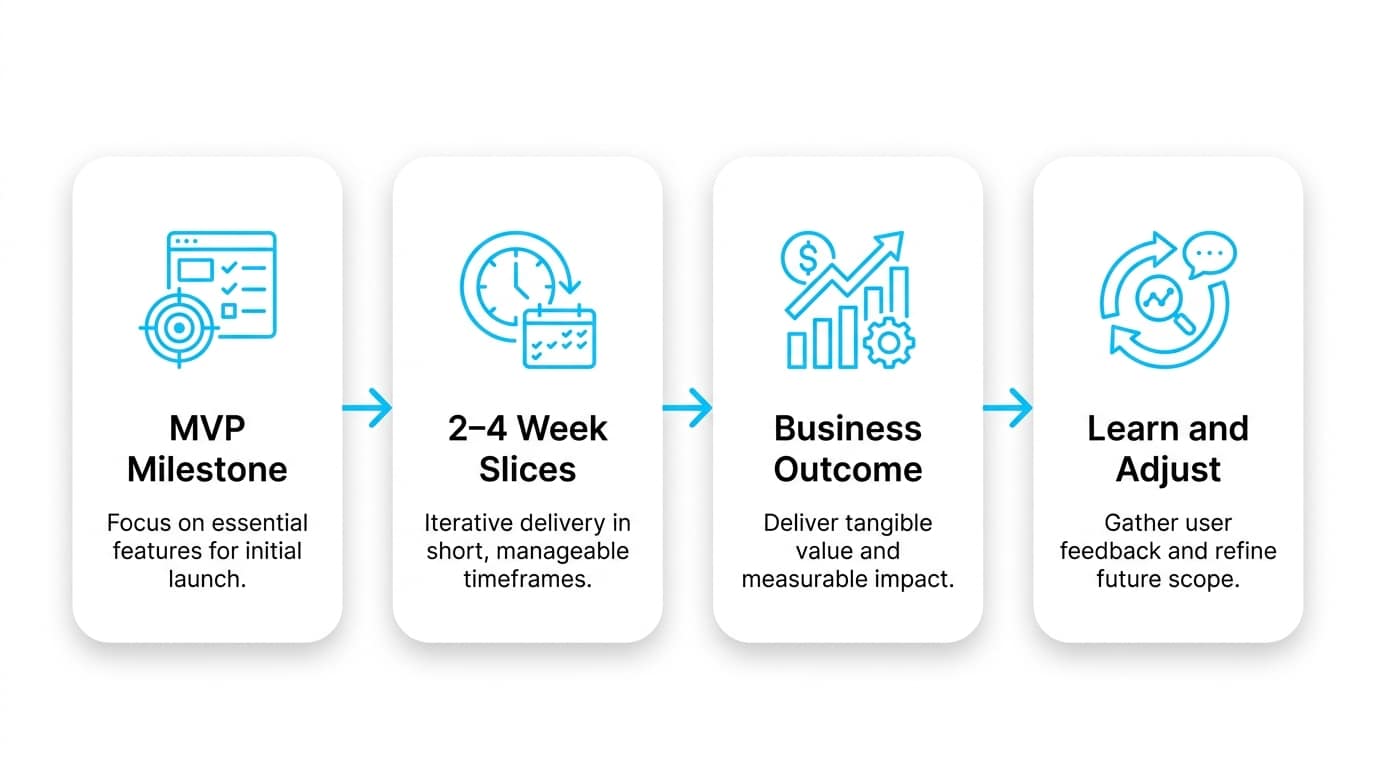
Trying to write a perfect requirements document before development begins is one of the fastest ways to slow a project down and increase its cost. By the time the document is finished, the market has moved. Instead, define scope in terms of business outcomes and MVP milestones. Break the vision into thin, valuable slices that can ship in two to four weeks. Each slice gives you something to learn from, adjust around, and prioritize against.
The goal is not to predict the future — it is to build a system that lets you respond to it without renegotiating the contract every month. User stories with clear acceptance criteria, a prioritized backlog visible to both sides, and a shared definition of “ready” (the criteria a story must meet before it enters a sprint) are the three artifacts that make this work in practice.
- Business objective and measurable success metric
- MVP features ranked by user and business value
- Explicit out-of-scope exclusions
- Non-functional requirements (performance, security, compliance)
- Integration dependencies and third-party constraints
- Pixel-perfect UI specifications before UX validation
- Exhaustive edge-case enumeration upfront
- Architecture decisions locked before discovery
- 100-page functional specifications with change-control bureaucracy
- Waterfall milestones tied to fixed delivery dates months away
Which Internal Roles Must You Have in Place?
Even the best external team cannot replace the three roles you must have on your side. First, a Product Owner who makes product decisions, prioritizes the backlog, and is available to the team daily. Second, a Technical Lead — even part-time — who safeguards architectural continuity, reviews critical decisions, and owns the handover of knowledge back to your organization. Third, a Business Stakeholder who can prioritize trade-offs based on company strategy when scope conflicts arise.
When any of these roles is missing, decisions stall, scope drifts, and the partner ends up guessing. When all three are present and engaged, the partnership becomes predictable, fast, and genuinely aligned. A common mistake is to assume the partner can fill gaps in internal leadership — they can inform and advise, but the accountability must remain on your side.
Building a Development Collaboration Framework
A reliable cadence beats a brilliant improvisation every time. Whether you choose Scrum, Kanban, or a hybrid, what matters is consistency: planning, execution, review, and retrospective happening on the same days every cycle, with the same participants, and with outputs that feed directly into the next cycle. Standardized methodologies for ICT project management are well documented in public-sector references such as the Israeli government framework for software development services management, which lists Agile and Scrum among the recommended approaches for managing external technology engagements.
What Meeting Routines Are Actually Necessary?
You need fewer meetings than you think — but the ones you keep must be treated as non-negotiable. A short weekly planning session, a mid-week sync to surface and unblock issues, and an end-of-week demo cover the needs of most teams. Daily standups are valuable when the team is large or distributed, but they should be cut when they become status theater rather than genuine working sessions. The test: does each meeting produce a decision or an unblocked dependency? If not, reduce the frequency and invest the time in async documentation instead.
What Documentation Keeps You Fast Without Bureaucracy?
Document decisions, not discussions. Architecture decision records (ADRs), API contracts, runbooks for production incidents, and a clear onboarding document are the practical minimum. Everything else can live in tickets and code comments. The test is simple: if a new engineer joins next month, can they ship in their first week using only the existing documentation? If the answer is no, the documentation is under-invested — and the cost of that gap grows with every new team member who onboards.
Mastering Communication and Expectation Management
Most partnership failures are communication failures dressed up as technical ones. The root cause is usually ambiguity: who owns this decision, what was agreed, and who needed to know. Define communication channels explicitly — chat for fast questions, ticketing systems for tracked work, email or shared documents for formal decisions — and set response-time expectations for each channel. Use a lightweight RACI matrix so everyone knows who is Responsible, Accountable, Consulted, and Informed for each major decision category.
Write decisions down. “We agreed on Tuesday” is not a contract. A message in your shared channel with a clear summary and explicit acknowledgment from the right person is. The small discipline of decision documentation is what separates partnerships that scale cleanly from those that accumulate invisible misalignments until a crisis forces a painful realignment conversation.
Research on distributed software teams consistently identifies communication clarity — not technical skill — as the primary predictor of project outcome. Teams that document decisions asynchronously ship faster and with fewer regressions than those that rely on verbal alignment in meetings.
How Do You Choose a Partner Who Actually Fits?
Technical skill is the baseline, not the differentiator. Every credible partner can write working code. The partners who succeed long-term share three traits: cultural fit with your team’s way of working, transparency under pressure when something goes wrong, and a track record of operating effectively in ambiguity — because your product will be ambiguous, and they need to be comfortable in that space without becoming paralyzed.
Ask to speak with engineers, not just account managers. Ask how they handled their last failed project: what went wrong, what they did differently as a result, and how they would handle it again. Watch how they answer questions they do not know the answer to — confident humility beats confident bluffing every time. This is precisely where a boutique partner like Sentice differentiates itself: small, senior teams embedded in your workflow, with the ability to make commitments and keep them without layers of escalation between you and the engineers writing your code.
Essential Questions to Ask Before Signing
The interview process is your single best tool for predicting how the partnership will actually feel day-to-day. Use it well — not to test knowledge, but to observe behavior under the conditions that matter most.
Process and Management
Ask: How do you handle technical debt accumulation during a period of fast delivery? How do you re-prioritize mid-sprint when the business changes direction? How do you onboard a new engineer onto an existing project with minimal disruption? The quality of these answers reveals whether the team has repeatable, well-internalized processes or whether they improvise anew every time a familiar challenge appears.
Quality, Testing, and Security
Ask about automated test coverage targets, mandatory code review policies, and how security vulnerabilities are detected and patched within the development lifecycle. Israeli regulatory guidance on information security requirements for outsourcing risks sets a practical baseline for what a serious partner should already be doing — including risk assessments, data minimization commitments, and cloud security controls. A partner who cannot speak fluently to these topics is a partner who will create compliance risk for your organization.
Post-Launch Support and Maintenance
Ask how knowledge is transferred to your internal team during and after the engagement, how production bugs are triaged against feature work, and what the on-call or incident response structure looks like after go-live. A partner who has no structured answer here is implicitly planning to disappear after launch — leaving you with a codebase you do not fully understand and no escalation path when something breaks at 2am.
Which Pricing Model Should You Choose?
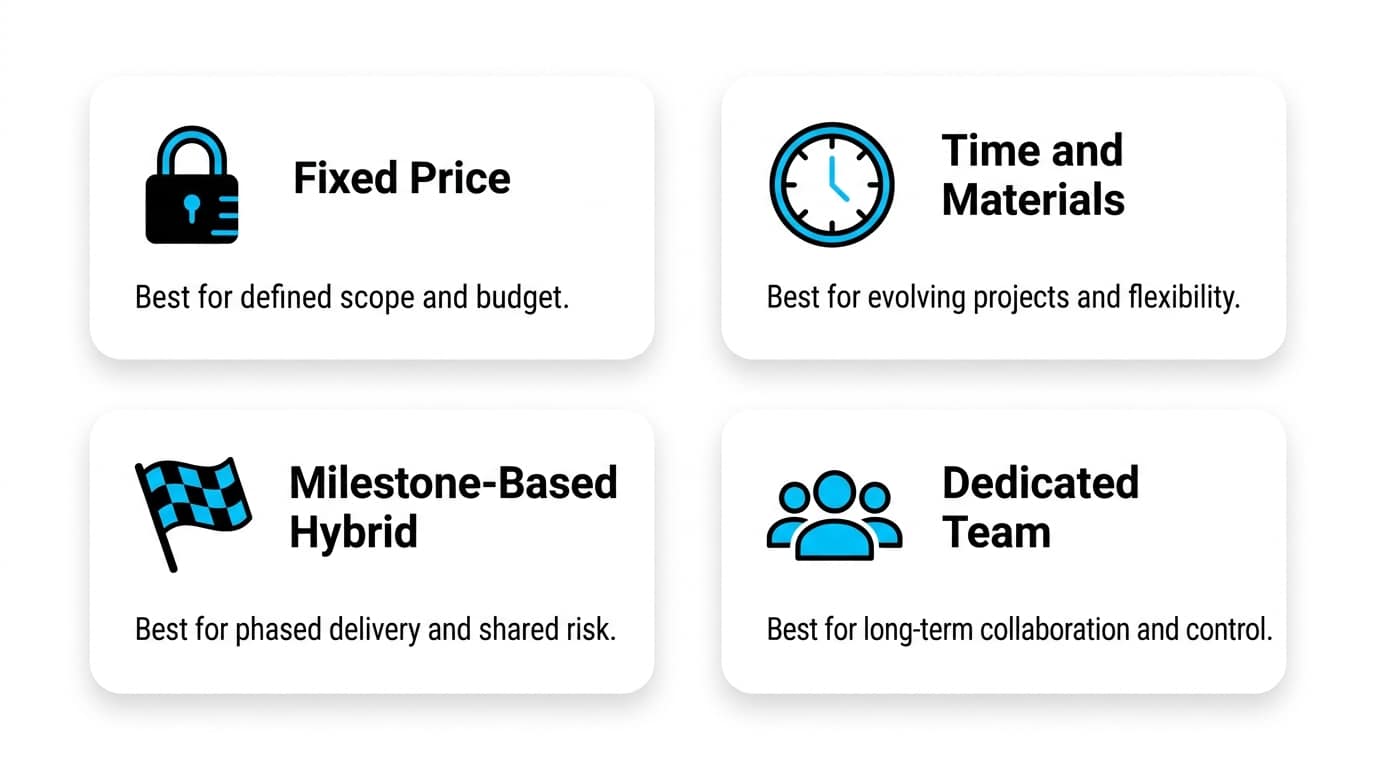
There is no universally correct pricing model — there is only the model that matches your current level of certainty about scope, timeline, and requirements. The table below maps each model to the conditions that make it the right choice, and the risk you accept when you choose it.
| Model | Best For | Main Risk |
|---|---|---|
| Fixed Price | Well-defined, stable scope with clear acceptance criteria | Scope conflicts and change-order disputes when reality diverges from the spec |
| Time and Materials | Evolving products, R&D exploration, MVPs still finding their shape | Requires active oversight and a high degree of trust to avoid scope inflation |
| Milestone-Based Hybrid | Phased delivery with clear business checkpoints between phases | Negotiating each milestone in advance consumes time and relationship capital |
| Dedicated Team | Long-term partnerships with an embedded squad acting as a team extension | Requires strong internal product leadership to direct and prioritize effectively |
For most scaleups building or evolving a core product, the dedicated team model — where a consistent group of engineers embeds into your organization with a predictable monthly cost — delivers the best combination of speed, quality, and trust-building over time.
What Must Be in the Agreement to Protect You?
A solid agreement makes the partnership stronger, not more bureaucratic. It removes ambiguity from the relationship so both sides can focus on delivery rather than on what was “really meant” by a particular clause. The essential terms to cover: IP ownership of all code and documentation, confidentiality and NDA obligations, security requirements, liability limits, and — critically — exit and knowledge-transfer terms agreed before they are ever needed. Israeli framework procedures explicitly require external parties to sign a dedicated information security annex covering all access paths to data, a useful structural template even for partnerships operating outside the public sector.
Who Owns the Code and the IP?
Make ownership explicit and unconditional: all source code, infrastructure-as-code, documentation, and design assets transfer to you upon payment, with no residual claims. The one carve-out to negotiate clearly is generic, reusable libraries the partner brings into the engagement — these should be licensed to you perpetually for the delivered product, even if ownership remains with the partner. “We’ll sort it out later” is not a position; it is a future dispute waiting to happen.
How Do You Avoid Lock-In?
Define exit terms before you need them. The minimum: full source code handover, documentation of all credentials, secrets, and infrastructure configurations, a defined transition period during which the partner remains available to answer questions, and formal revocation of all system access on the first day after the engagement ends. Exit terms defined under pressure favor the party with more leverage. Define them when both sides are motivated to be fair.
How Do You Maintain Code Quality Over Time?
Quality is a system, not an event, and it requires deliberate investment at every stage of the engagement. Mandatory code reviews — with documented review standards, not just approval buttons — automated testing in CI/CD pipelines, static analysis, dependency vulnerability scanning, structured logging, and a defined process for paying down tech debt on a regular cadence are all non-negotiable in a serious partnership.
A partner that treats these practices as optional overhead will leave you with a codebase that becomes progressively harder and slower to change each quarter — precisely the quarters when speed matters most. Quality metrics to track alongside delivery metrics: test coverage percentage, static analysis violation count trend, dependency age, and time-to-fix for identified vulnerabilities. Together, these give you early warning signals before technical debt becomes an emergency.
Managing Scope Changes Without Blowing Up the Budget
Change is inevitable; chaos is optional. The goal of a change management process is not to prevent change — it is to make the cost and trade-offs of change visible before a decision is made. Implement a lightweight mechanism: every significant change request goes through a brief impact assessment covering effort estimate, risk, and dependency analysis, is prioritized against existing committed work by the Product Owner, and requires explicit business approval before it enters the backlog.
This three-step process takes less than 24 hours for most changes and prevents the two failure modes that kill budgets: scope creep that accumulates invisibly in small decisions, and urgent changes that bypass prioritization and destabilize the team. The phrase “yes, and here is what that means for the current sprint” is the most productive response a partner can give to a mid-cycle change request — it keeps momentum while maintaining honesty about trade-offs.
Security, Permissions, and Access Governance
Apply the principle of least privilege from the very first day of the engagement: every external team member receives access only to the systems, repositories, and data they actively need, scoped by both environment and role. Separate development, staging, and production environments are mandatory — not a nice-to-have. Log all access to production systems. Maintain a documented offboarding procedure that revokes all credentials, tokens, and repository access within 24 hours of someone rolling off the project.
For organizations operating under Israeli privacy regulations, the official guide for implementing the privacy protection (information security) regulations provides practical checklists you can adapt directly into your access governance policy. Conduct periodic access reviews — quarterly at minimum — to ensure permissions remain current as team composition changes. The cost of a credentials audit is trivial compared to the cost of a breach caused by a stale access token.
Every external engineer should have a named account, MFA enabled, production access only through a bastion or audit-logged gateway, and a written offboarding checklist tied to their contract end date. These four controls eliminate the most common external access vectors.
What Does a Healthy Weekly Routine Look Like?
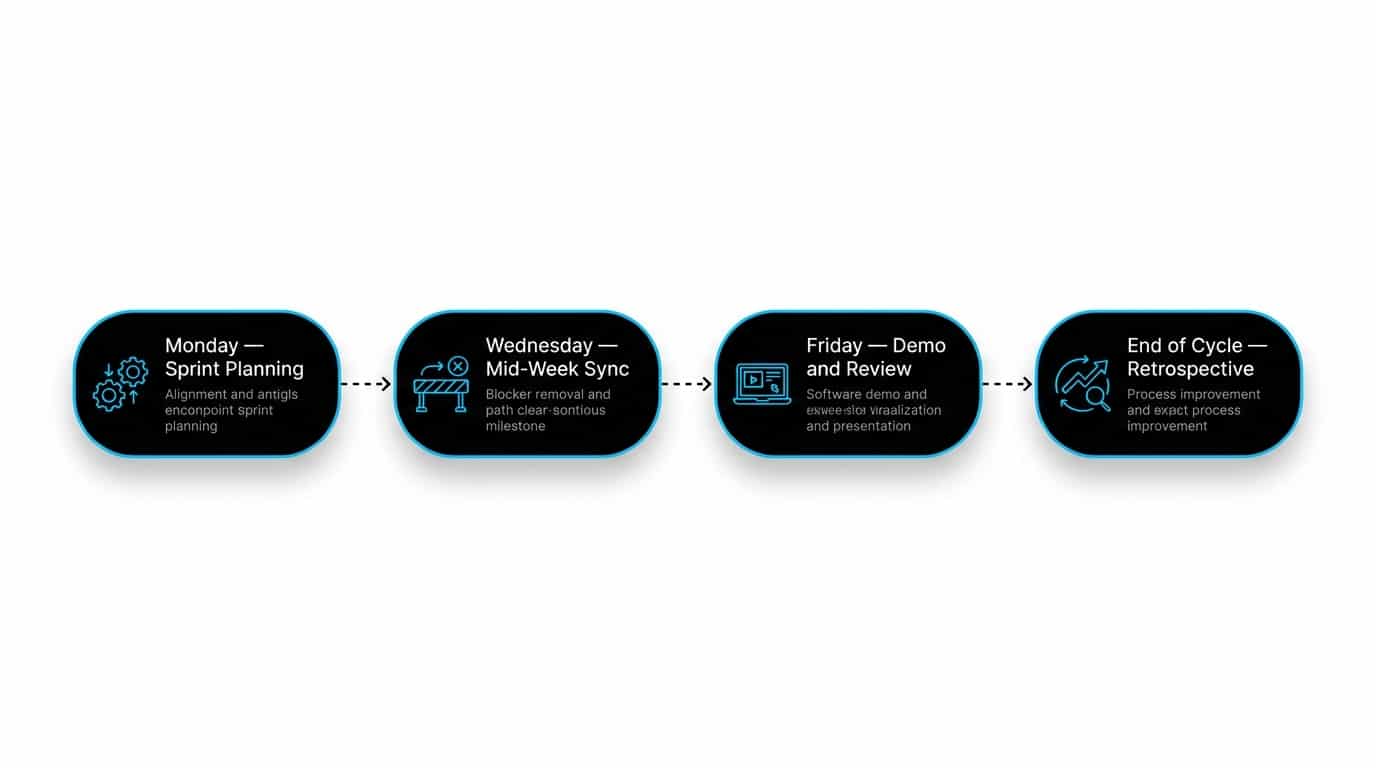
Predictability is a superpower in product development. Teams with consistent, reliable rhythms ship more frequently, catch problems earlier, and build trust faster than teams that operate ad hoc. A typical effective week at a well-run technology partnership looks like this:
| Day | Activity | Purpose |
|---|---|---|
| Monday | Sprint planning / weekly priorities | Align both sides on what ships this week and who owns each piece |
| Wednesday | Mid-week sync | Surface blockers early, adjust scope if needed, prevent Friday surprises |
| Friday | Demo and business review | Show working software, gather feedback, decide priorities for next cycle |
| End of cycle | Retrospective | Improve the process itself — not just the product — with honest two-way feedback |
The retrospective is the most under-invested ritual in most partnerships. Teams that hold genuine retrospectives — where both sides can surface friction, not just the client commenting on the partner’s performance — improve their delivery velocity measurably over time. Schedule it, protect it, and act on what surfaces within the next sprint.
Defining KPIs That Actually Predict Success
Measure what drives outcomes, not what is easy to count. Story points completed per sprint is easy to count; it predicts almost nothing about business impact. The following three categories of metrics, tracked together, give you a complete picture of partnership health.
Delivery Metrics
Track lead time from code commit to production deployment and deployment frequency. These DORA-style metrics are well established in the research literature, including benchmarking proposals for DevOps practices, and they correlate strongly with overall team performance. Use them as conversation starters — prompts to understand what is causing friction — not as scorecards used to penalize the team when numbers dip.
Reliability Metrics
Track change failure rate (the percentage of deployments that require a hotfix or rollback) and mean time to recovery (MTTR) when incidents occur. A high deployment frequency means very little if half the deployments break production. Together, these four metrics give you a balanced view of both speed and stability — the combination that actually builds user trust and compound velocity over time.
Business Outcome Metrics
Tie the partnership directly to business KPIs: time-to-market for new features, conversion impact of shipped changes, user retention trends, and infrastructure cost per active customer. This is what separates a true tech partner from a tech vendor — a genuine partner cares about these numbers as much as you do, and they proactively surface insights that might affect them, even when those insights are uncomfortable.
Mapping Business Needs to What a Boutique Partner Delivers
The advantage of a boutique partnership model becomes concrete when you map it to the specific business needs that scaleups face as they grow. The following table reflects how Sentice addresses each need in practice, drawing on its model of embedded senior teams operating as a genuine extension of your organization.
| Business Need | What Sentice Provides in Practice |
|---|---|
| Scaling capacity without losing quality | Senior embedded engineers integrated into your team’s workflow, tools, and communication channels from day one |
| Faster time-to-market | End-to-end SDLC ownership with a single accountable point of contact — no handoff chains, no communication layers |
| Local context and time-zone alignment | Israel-based teams aligned to your business hours, cultural norms, and regulatory environment |
| Predictable delivery | Dedicated team model with consistent weekly cadence, shared KPIs, and transparent progress reporting |
| Long-term product evolution | Architecture review and tech debt management built into the engagement from the start, not bolted on later |
Red Flags That Should Stop You from Signing
The evaluation stage is your best and cheapest opportunity to avoid a bad partnership. Watch for these warning signs: vague or evasive answers about internal process, no concrete examples of how they recovered from a past project failure, refusal to share individual engineer profiles or allow direct conversations with the people who will work on your code, no documented testing strategy, dependency on a single “hero” engineer without any succession or bus-factor planning, reluctance or delay in discussing exit terms, and a tendency to over-promise on timelines without asking enough clarifying questions first.
Any single one of these is a yellow flag worth probing further. Two or more appearing together is a clear signal to walk away — not because the team is incompetent, but because the cultural conditions for a healthy, transparent partnership are not present. The discomfort of walking away from an evaluation is far smaller than the cost of a failed engagement six months in.
When to Deepen the Partnership and When to Transition Out
Healthy partnerships either grow intentionally or end intentionally — they should not simply drift in either direction. Deepen the relationship when delivery is consistently meeting or exceeding targets, when the partner is proactively bringing ideas and improvements you did not ask for, and when your internal team is visibly learning and growing through the collaboration. These are signs that the partnership is generating compound value, and that the investment in relationship depth will continue to pay returns.
Plan a transition when delivery has plateaued despite process improvements, when the project’s complexity or scale has grown beyond the partner’s current strengths, or when the quality of communication has declined over multiple quarters despite repeated and direct feedback. Either way, make the decision based on data and honest conversation rather than accumulated frustration. A well-managed exit — with full knowledge transfer, clean documentation, and mutual respect — is often the foundation for a future re-engagement when the fit is right again.
Frequently Asked Questions
How long does it take to onboard a new technology partner?
A well-prepared onboarding takes two to four weeks for a partner to become meaningfully productive on a defined scope. Faster is possible when you have strong documentation, a clear MVP target, and an available internal Technical Lead. Slower timelines usually signal unclear internal ownership or an undocumented codebase rather than partner capability issues.
Should we hire in-house or work with a technology partner?
It is rarely an either/or decision. The most effective pattern for scaleups is a small in-house core team that owns product direction and architecture, augmented by a partner team that scales delivery capacity and brings specialized expertise. This combination gives you strategic continuity alongside the flexibility to ramp capacity up or down as your roadmap evolves.
How do we protect sensitive data when working with an external team?
Apply least-privilege access controls, maintain separate development and production environments, enable comprehensive logging on all production access, and document a formal offboarding procedure. Sign a dedicated information security annex as part of the contract, conduct periodic access reviews, and align your controls with applicable national privacy regulations for your industry and jurisdiction.
What is a realistic budget for a serious technology partnership?
Budgets vary widely depending on team size, seniority, and engagement duration. Plan based on the size and composition of the embedded team over time, not on per-feature or per-ticket pricing. Expect the first quarter to require meaningful investment in foundations — architecture, tooling, documentation, and relationship-building. This investment pays back in compounding delivery speed for the remainder of the engagement.
How do we measure whether the partnership is actually working?
Combine three measurement categories: delivery metrics (lead time to production, deployment frequency), reliability metrics (change failure rate, mean time to recovery), and business outcome metrics (time-to-market for new features, feature adoption rates, infrastructure cost per customer). If all three categories trend positively over two consecutive quarters, the partnership is working. If one category lags, that signals where the conversation needs to go next.
Can a boutique partner really replace a large agency?
For most scaleups, yes — and frequently with better outcomes. Boutique partners like Sentice offer senior engineers with direct accountability, fewer internal handoffs between you and the people writing your code, and a genuine incentive to maintain quality because their reputation depends on it. Large agencies offer greater raw capacity, but often at the cost of communication layers, junior resource substitution, and account management overhead that distances you from the actual work.
What should we expect in the first 30 days of a new partnership?
The first 30 days should focus on discovery and foundation-setting: codebase review, architecture assessment, backlog refinement, tooling and access setup, and the establishment of communication rhythms. The first meaningful deliverable — even a small one — should ship within the first sprint to establish momentum and validate that the integration is working. If no code ships in the first 30 days, that is a signal that onboarding or alignment is taking longer than expected and requires direct attention.
How do we handle time-zone differences with an external partner?
Overlap hours are more valuable than matching hours. Identify the three to four hours per day where both sides are available simultaneously and protect those for synchronous decision-making. Use the non-overlap hours for focused delivery work and async updates via documented tickets and shared channels. Sentice’s Israel-based teams operate within a comfortable overlap window with most European and African markets, and with early-morning or late-day alignment for US East Coast teams.

Sentice is a boutique tech partner that builds custom software solutions for startups and scaleups. We embed senior engineers into your product organization as a real extension of your team — culture-aligned, end-to-end, and committed to your roadmap.