
Web Application Development Services: A Complete Guide for Startups and Scaleups
Everything you need to evaluate, choose, and succeed with the right web application development partner for your product.
- Web application development services cover the full lifecycle — discovery, architecture, development, QA, DevOps, and ongoing maintenance — not just coding.
- Custom development outperforms off-the-shelf SaaS when your business logic is unique, regulated, or strategically differentiating.
- Choosing the right engagement model — fixed scope, time and materials, or embedded team — directly impacts delivery speed and budget predictability.
- Security must be embedded throughout development, not added as a post-launch checklist item, to reduce cost and risk across the product’s lifetime.
- Performance, scalability, and long-term maintenance are first-class requirements, not optional extras, for products serving growing businesses.
- A boutique tech partner that embeds senior engineers into your team delivers alignment, continuity, and measurable business outcomes beyond feature delivery.
Table of Contents
- Understanding Web Application Development Services
- Web Applications vs. Websites: What Defines the Difference?
- When to Choose Custom Development Over Off-the-Shelf Software
- The Core Phases of a Successful Web Application Project
- How to Compare Engagement Models
- Choosing the Right Technology Stack
- Common Mistakes That Derail Web Application Projects
- Integrating APIs and Third-Party Systems
- Security and Data Protection Standards
- Performance and Scalability for Growing Businesses
- How a Boutique Partner Maps to Real Business Needs
- Measuring Success in Web Application Development Services
- The Role of Long-Term Maintenance and Support
- Frequently Asked Questions
For today’s startups and scaleups, the browser has become the primary battleground for customer experience, internal operations, and competitive differentiation. Yet many founders and tech leaders discover that building a robust, secure, and scalable product is far more demanding than simply hiring developers. Choosing the right web application development services means choosing a partner who understands the full lifecycle of your product — from the first whiteboard sketch to the moment your users depend on it daily.
This guide walks you through what these services truly include, how to evaluate them, and how to make decisions that protect your roadmap and your budget. Whether you are exploring your options for the first time or re-evaluating a relationship that has stopped working, Sentice has built this resource to help your team move forward with clarity and confidence.
Understanding Web Application Development Services
Web application development services go far beyond writing code. They cover the entire lifecycle of a digital product: discovery, architecture, UI/UX design, development, quality assurance, deployment, and DevOps. The goal is to deliver a system that runs complex business processes inside a browser, eliminating the need for native desktop installations and giving your team the flexibility to work from anywhere.
A serious engineering effort means thinking about user flows, data models, integrations, and operational reliability before any feature is built. This is where a boutique tech partnership changes the equation: instead of receiving code, you gain a dedicated team that aligns with your business outcomes and ensures the product matches the strategy behind it.
The phase where users, goals, key flows, and acceptance criteria are defined. It produces a shared understanding of scope, priorities, and risks before a single line of code is written.
The complete Software Development Life Cycle — from requirements and design through development, QA, deployment, and maintenance — managed as a single, continuous engineering practice.
The discipline of automating and integrating the processes between development and IT operations to enable faster, more reliable delivery and continuous improvement in production.
Web Applications vs. Websites: What Defines the Difference?
A website is built primarily for content consumption: marketing pages, blogs, and informational sections that visitors browse passively. A web application, by contrast, is interactive software. It authenticates users, performs CRUD operations on data, executes business logic, manages roles and permissions, and often integrates with payment, billing, or analytics systems.
That difference explains why custom web solutions demand a more rigorous engineering approach. Estimating effort by “number of pages” is misleading when each screen represents authenticated workflows, validation rules, and audit trails. Treating a web app like a website is one of the most common reasons projects miss their budget and timeline expectations.
When scoping your project, count authenticated user journeys and state transitions — not screens. A single screen that handles role-based access, validation, and async API calls carries the same engineering weight as five informational pages combined.
When to Choose Custom Development Over Off-the-Shelf Software
Off-the-shelf SaaS tools are excellent when your workflow matches the product’s assumptions. The moment your business logic becomes unique, regulated, or strategically differentiating, web-based software built specifically for your needs becomes the better path. Custom development gives you full control over data, integrations, and user experience. SaaS gives you speed and predictability.
The trade-off is between time-to-market and long-term scalability. If your competitive advantage depends on automation, proprietary data, or deep integrations, custom development pays back with leverage. If your need is generic and the workflow is standard, a SaaS shortcut is often smarter. The right answer is rarely binary — many successful products combine a custom core with best-in-class SaaS components for non-differentiating functions.
- Your business logic is unique or regulated
- You need full ownership of your data
- Deep integrations are a competitive requirement
- Proprietary automation is your differentiator
- Long-term scalability outweighs initial speed
- Your workflow matches the tool’s assumptions
- Speed to market is the primary constraint
- The function is generic and non-differentiating
- Budget is fixed and scope is well-defined
- Vendor support reduces your operational burden
The Core Phases of a Successful Web Application Project
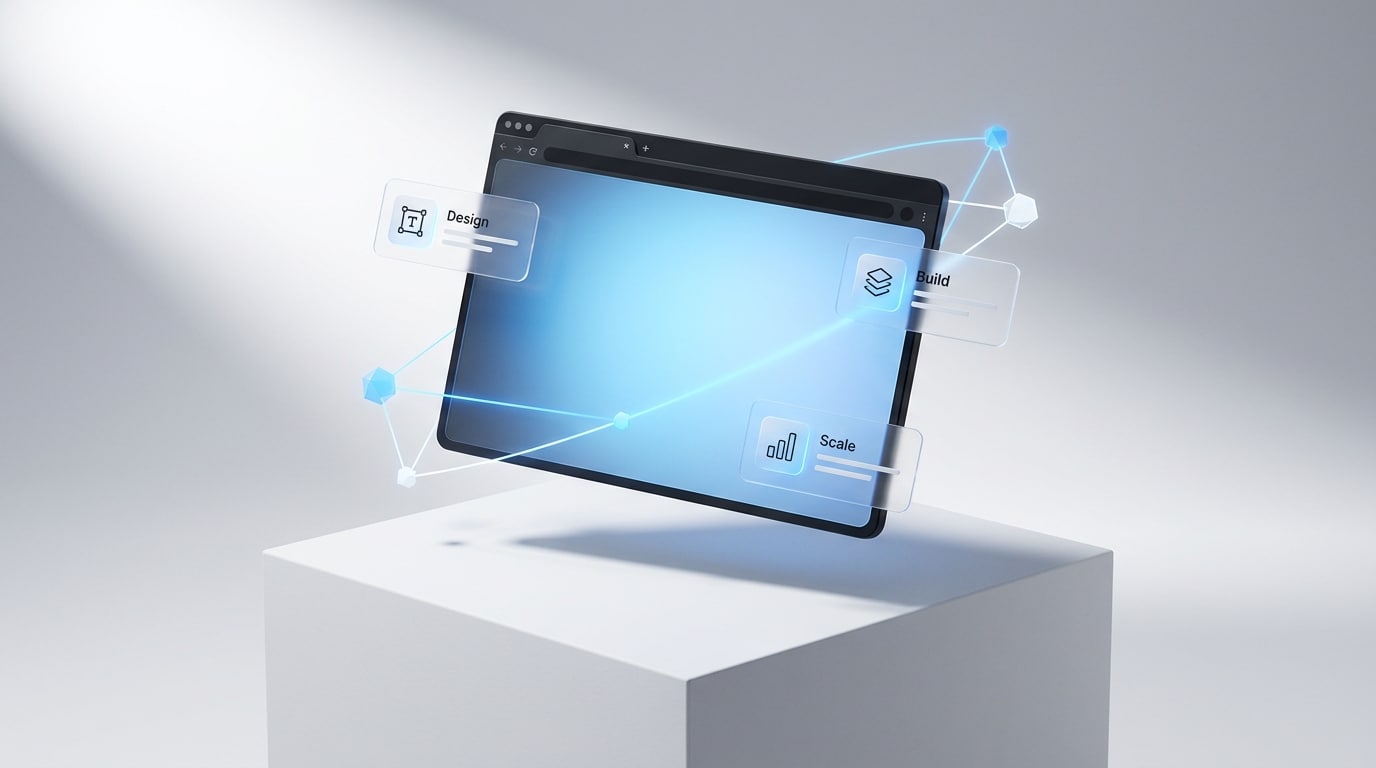
Every successful project follows a deliberate cadence. Skipping phases to “save time” almost always increases total cost. The structure below reflects how mature engineering teams move from idea to production without losing speed or quality.
The Discovery Phase
Discovery is where you define users, goals, key flows, and acceptance criteria. The output is a shared understanding of scope, priorities, and risks. Without it, teams build features that nobody asked for and miss the ones that matter most. A well-run discovery phase typically takes one to three weeks and saves multiples of that time during development by eliminating misaligned assumptions before they become expensive rework.
Agile Development and Prototyping
Modern delivery is iterative. You build small increments, test them, gather feedback, and adjust. Security must be embedded into every iteration, not bolted on at the end. Frameworks like the NIST Secure Software Development Framework describe how secure-by-design practices should live inside the SDLC, from requirements to release. The principle is simple: security is cheaper when it is part of the design, not a patch after launch.
Quality Assurance and Deployment
QA is continuous, not a final stage. Automated tests, code reviews, staging environments, and deployment pipelines reduce risk and shorten the feedback loop. A good launch plan also includes monitoring, alerting, and a rollback strategy so that the first day in production does not become a crisis management exercise.
At Sentice, we embed QA into every sprint as a first-class practice — not a gate at the end. Defect rates measured in production are consistently lower when testing is woven into the development rhythm rather than treated as a separate handoff.
How to Compare Engagement Models in Web Application Development Services
Choosing how you engage a partner is as important as choosing the partner itself. Different models suit different stages of product maturity, and the right structure protects both delivery speed and budget predictability. The table below summarizes the four most common models and the conditions under which each performs best.
| Model | Best Suited For | Main Advantage | Key Risk to Manage |
|---|---|---|---|
| Fixed Scope | Well-defined MVPs, clear specifications | Predictable cost | Limited flexibility for change |
| Time & Materials | Evolving products, ongoing iteration | Adaptability to new insights | Requires strong product ownership |
| Embedded Team | Scaleups extending in-house capacity | Deep alignment and continuity | Onboarding investment upfront |
| Outcome-Based | Clear KPIs, mature stakeholders | Shared accountability | Requires precise success metrics |
For most startups and growing scaleups, an embedded team model delivers the strongest long-term results. Senior engineers who operate as a genuine extension of your team — culture-aligned and committed to your roadmap — close the gap between strategy and execution in ways that project-based models rarely achieve.
Choosing the Right Technology Stack
There is no universally “best” stack — only the one that fits your performance, security, and scalability needs. The right choice balances developer availability, ecosystem maturity, hosting costs, and long-term maintainability. Clean architecture matters more than fashionable frameworks: it prevents technical debt and lets the system evolve as your business grows.
Tech decisions made during MVP development set the foundation for everything that follows, so they should be evaluated against where you want the product to be in two or three years, not only the next sprint. A partner with strong architectural judgment will push back on premature optimization and equally on shortcuts that create invisible constraints for your future engineering team.
According to industry research, technical debt reduction is consistently cited among the top engineering priorities for scaleups. Teams that invest in architecture-first thinking during early development spend significantly less time on remediation work in subsequent years — protecting velocity when it matters most.
Common Mistakes That Derail Web Application Projects
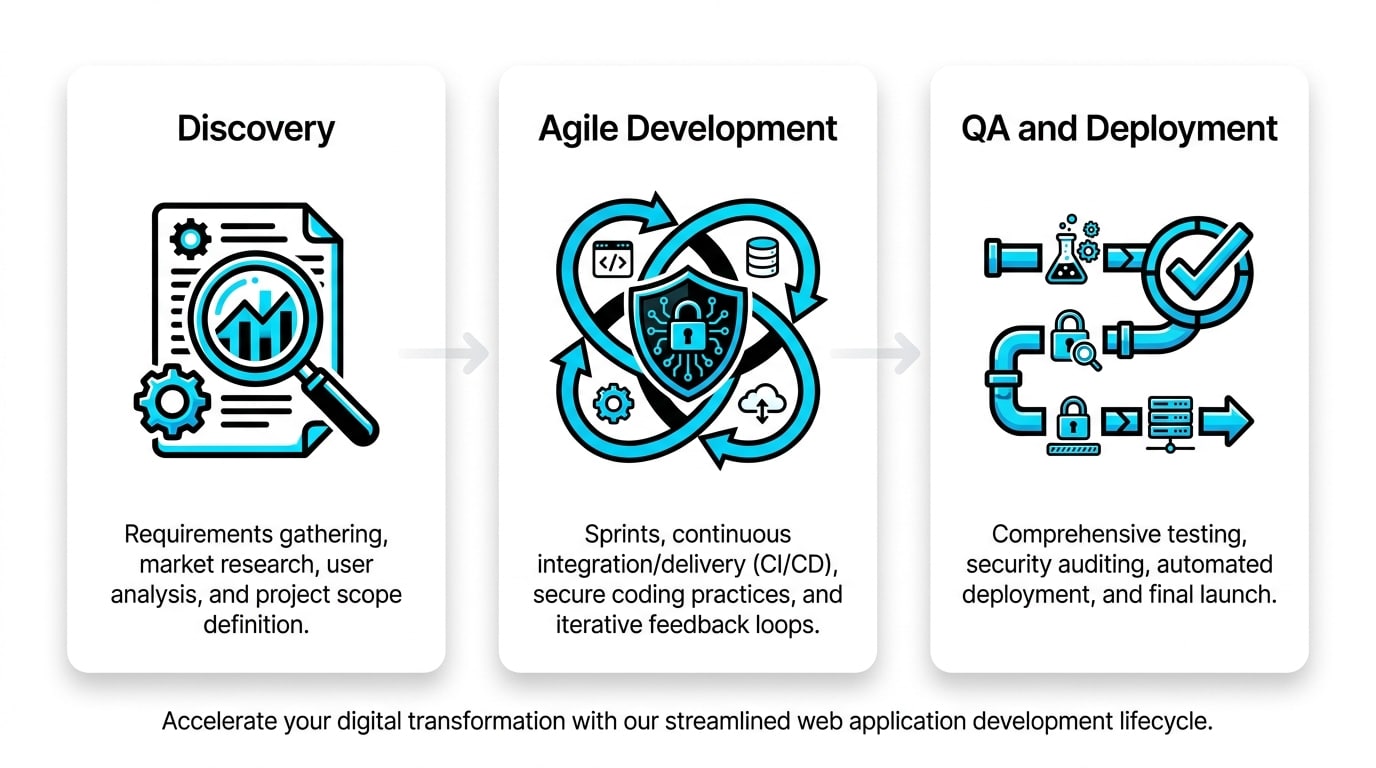
Most failed projects share a similar set of avoidable errors. Understanding them in advance saves months of recovery work and protects your roadmap from unnecessary detours. The patterns below are consistent across industries and team sizes — and each one has a practical, preventable fix.
| Mistake | Why It Happens | Practical Fix |
|---|---|---|
| Vague requirements | Pressure to start coding fast | Invest in a structured discovery phase |
| No definition of done | Assumptions replace agreements | Document acceptance criteria per feature |
| Security as an afterthought | Treated as a launch checklist item | Embed security in every sprint |
| Ignoring performance early | Focus only on functionality | Set performance budgets from day one |
| Underestimating integrations | Third-party complexity is hidden | Map integrations during architecture |
Integrating APIs and Third-Party Systems
Modern custom web solutions rarely live in isolation. They connect to CRMs, ERPs, payment gateways, communication platforms, and analytics tools. APIs are the connective tissue that turns a standalone product into an integrated part of your business ecosystem. Designing an API-first architecture means treating every internal capability as a service that can be consumed, reused, and scaled independently.
Standards like OAuth 2.0 provide a proven approach for handling authorization between systems, which is essential when your product exchanges data with external partners or exposes its own API to clients. Every integration point is also a potential vulnerability and a dependency risk — both of which should be mapped and addressed during the architecture phase, not discovered during QA.
Treat third-party integrations as first-class architectural components, not implementation details. Define fallback behavior, rate-limit handling, and data contract versioning before development begins. Integration failures discovered late in the SDLC are among the most expensive delays a product team can face.
Security and Data Protection Standards
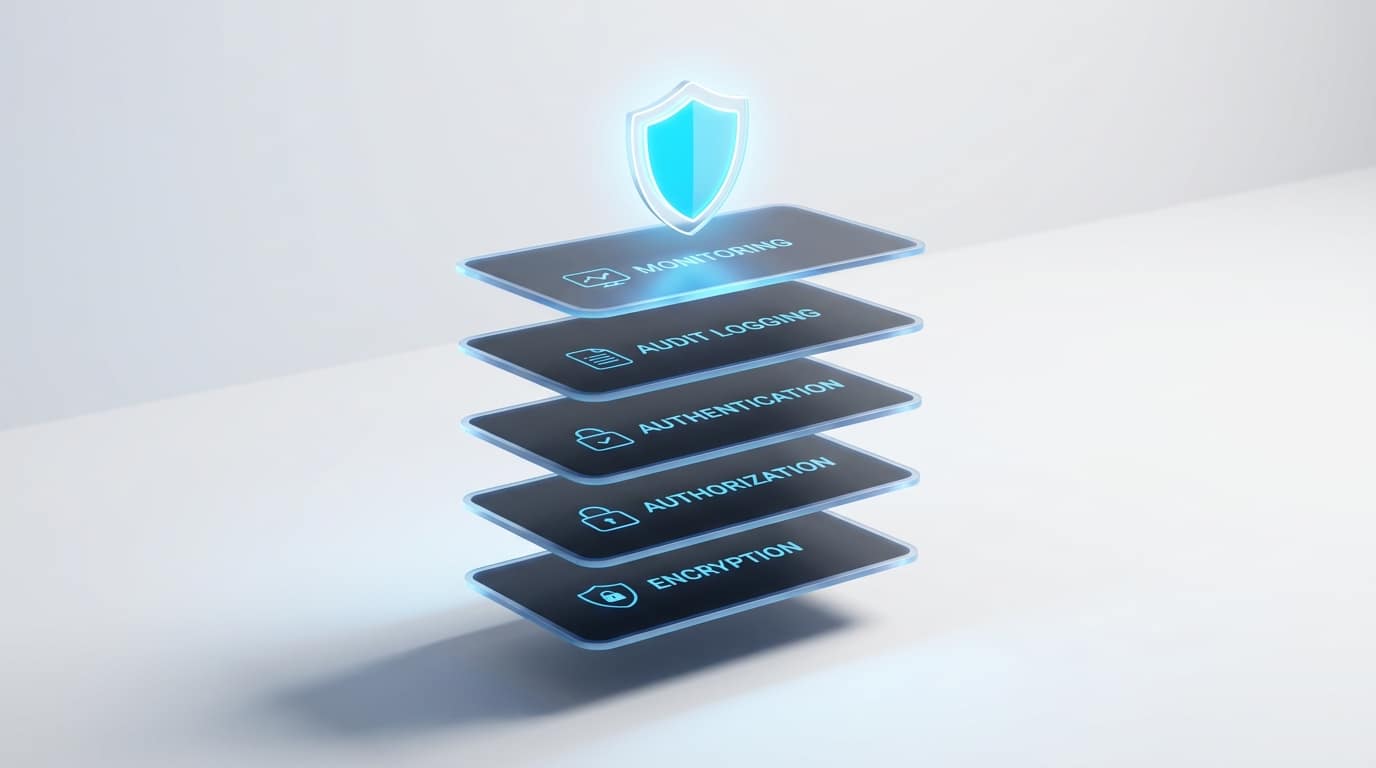
Security is an architectural decision, not a feature you add later. Strong web application development services treat authentication, authorization, encryption, secret management, and audit logging as foundational layers. Role-based access control protects sensitive operations, while continuous monitoring detects anomalies before they become incidents.
Reference resources such as the OWASP Top 10 help teams systematically address the most common application risks, from injection vulnerabilities to broken access control. The earlier these concerns enter the design conversation, the lower the cost of mitigation across the product’s lifetime. A team that normalizes security reviews within each sprint invests a fraction of what reactive remediation costs after a breach or audit finding.
- Authentication and session management
- Role-based access control (RBAC)
- Encryption at rest and in transit
- Secret and credential management
- Audit logging and anomaly detection
- Dependency vulnerability scanning
- OWASP Top 10 review per release cycle
- Penetration testing before major launches
- Security-focused code reviews
- Incident response planning and runbooks
Performance and Scalability for Growing Businesses
Speed and responsiveness directly impact adoption, retention, and conversion. Performance is built through deliberate decisions in database design, caching strategy, asset delivery, and background processing. Scalability is the ability to absorb traffic spikes without degrading the experience or inflating cloud costs.
Web application development services should include baseline monitoring from day one, with clear metrics for latency, error rates, and resource usage. Treating performance as a first-class requirement — rather than a post-launch optimization — prevents the kind of expensive rework that slows down growing businesses at exactly the wrong moment. When your product is gaining traction is precisely when you cannot afford to rebuild its foundations.
How a Boutique Partner Maps to Real Business Needs
Beyond methodology, what matters most is how a partner’s capabilities translate into outcomes you can feel inside your business. A culture-aligned embedded team closes the distance between your product vision and production reality in ways that transactional outsourcing rarely achieves. The table below maps common needs to the practical value a dedicated partnership brings.
| Business Need | How an Embedded Partnership Helps |
|---|---|
| Launching faster without sacrificing quality | Senior, culture-aligned engineers integrated directly into your workflow |
| Predictable delivery and transparent progress | Clear sprint cadence, shared tooling, and continuous visibility |
| Scaling capacity for product roadmap pressure | Flexible team composition that grows with your milestones |
| Reducing technical debt over time | Architecture-first mindset and ongoing engineering ownership |
| Long-term continuity beyond initial launch | Sustained collaboration through maintenance and evolution |
One of the most effective ways to evaluate a development partner is to begin with a focused, well-scoped engagement — an MVP or a defined feature set — before committing to a longer roadmap together. This approach reduces risk on both sides and builds the trust and working patterns that underpin high-performance teams.
Measuring Success in Web Application Development Services
Successful projects are not measured only by features shipped. They are measured by adoption, reliability, and business impact. Track metrics across delivery (velocity, defect rates), product (active users, conversion, retention), and operations (uptime, response time, security incidents).
A good partner helps you define these indicators upfront and revisits them in every release cycle. When all stakeholders share the same definition of success, decisions become faster and trade-offs become easier to justify. This shared scorecard is what turns development from a cost center into a measurable growth engine. Industry frameworks like DORA metrics — deployment frequency, lead time for changes, change failure rate, and time to restore service — provide an objective lens for evaluating engineering performance over time.
The Role of Long-Term Maintenance and Support
Launch is the beginning of the product’s life, not the end. Ongoing support includes library updates, security patching, infrastructure scaling, performance tuning, and steady evolution based on real user behavior. Without it, even excellent software degrades over time as the technology landscape shifts and usage patterns evolve.
This is why end-to-end software development matters: the relationship between your team and the engineering partner continues long after the software goes live, ensuring the product keeps pace with your business and with the changing technology landscape around it. Building tomorrow’s solutions, together, means being present not just for the launch sprint but for every release cycle that follows.
Research consistently shows that the cost of maintaining a software product over its lifetime typically exceeds its initial build cost. Teams that plan for maintenance from day one — with documented architecture, automated tests, and clear runbooks — reduce that long-term cost substantially compared to teams that treat maintenance as an afterthought.
Frequently Asked Questions
What exactly is included in web application development services?
They include discovery, UI/UX design, frontend and backend development, database and API design, QA, DevOps, deployment, and ongoing maintenance. The goal is to deliver a working product that serves real users and real business processes — not just a codebase. A mature provider manages all of these phases as a coherent, end-to-end practice rather than a set of disconnected deliverables.
How long does it take to build a custom web application?
An MVP typically takes a few weeks to a few months, depending on the number of screens, integrations, role complexity, and quality requirements. Clear scope and fast product decisions shorten the timeline significantly. A well-run discovery phase — usually one to three weeks — is often the single highest-leverage investment in reducing total delivery time.
How much does a custom web application cost?
Cost is driven by functional scope, technical complexity, security requirements, and the maturity of your specifications. Breaking the budget into UX, development, QA, DevOps, and integrations makes proposals easier to compare across partners. Vague specifications consistently produce vague — and ultimately unreliable — cost estimates, so investing in a structured discovery phase before requesting quotes pays for itself in accuracy.
Should we build an MVP first or go straight to a full product?
An MVP is almost always the smarter path. It validates business value early while protecting the architectural foundation, so the product can grow without expensive rewrites later. The key is to distinguish between a true MVP — the minimum set of features needed to test a core hypothesis — and a “minimum” product that still carries all the complexity of a full release.
How do we choose the right development partner?
Look for relevant domain experience, transparent processes, strong product thinking, and clear ownership of code and IP. Ask how they handle change requests, QA, and post-launch support. Evaluate whether senior engineers will actually work on your product or whether the team you meet during the sales process differs from the team that delivers. References from previous clients at a similar stage are among the most reliable signals.
Is security really part of the development process or a separate effort?
Security must be embedded throughout development. Authentication, authorization, encryption, and secure coding practices are architectural decisions that influence every layer of the application. Treating security as a separate audit at the end of a project typically produces a long backlog of remediation work that delays launch and increases cost — the opposite of what the approach was intended to achieve.
What happens after the application goes live?
Maintenance includes monitoring, bug fixes, security updates, performance optimization, and feature evolution. A long-term partnership ensures the product continues to deliver value as your business changes. Without sustained engineering ownership, software entropy accelerates — dependencies fall out of date, performance degrades under growing load, and the cost of change increases with each passing quarter.

Sentice is a boutique tech partner that builds custom software solutions for startups and scaleups. We embed senior engineers into your product organization as a real extension of your team — culture-aligned, end-to-end, and committed to your roadmap.