
Mobile Application Development Services: A Complete Guide for Startups and Scaleups
How to evaluate, select, and partner with a mobile development team that aligns with your roadmap and scales with your growth.
- Quality mobile application development services cover the full lifecycle — from discovery and design through QA, deployment, and post-launch operations.
- Custom development pays off when your workflows are unique, security requirements are strict, or the mobile experience is itself a competitive differentiator.
- Vendor selection should be evidence-based: review architecture diagrams, QA reports, sprint artifacts, and verifiable client references before committing.
- A focused MVP typically ships in 8–16 weeks; enterprise-grade products require 4–9 months depending on integration depth and scale requirements.
- Post-launch maintenance, monitoring, and a shared quarterly roadmap transform a one-time project into a compounding product investment.
- Embedding senior engineers as a culture-aligned extension of your team — rather than outsourcing to a disconnected vendor — produces measurably better delivery outcomes.
Table of Contents
- What do mobile application development services actually include?
- When custom development beats off-the-shelf platforms
- How to choose a mobile app development company without falling for low-bid traps
- Vendor evaluation criteria at a glance
- The mobile application development process from discovery to launch
- How long does mobile app development take?
- How is the cost of mobile application development determined?
- Should you prioritize iOS, Android, or both?
- Native mobile development versus cross-platform solutions
- What to prepare before starting your project
- UX/UI design that drives retention and conversion
- Architecting secure and scalable backends and APIs
- Ensuring security and data privacy in mobile applications
- Common mistakes that create vulnerabilities
- The role of QA in reducing technical debt and costs
- Post-launch: maintenance, updates, and long-term support
- How Sentice supports mobile product teams
- Frequently asked questions
For today’s startups and scaleups, mobile is no longer a side channel — it is often the primary product surface where customers experience your brand, complete transactions, and decide whether to stay loyal. Choosing the right mobile application development services means choosing a partner who can translate business goals into a stable, secure, and scalable product, not just a team that writes code.
This guide walks you through what to expect from a quality mobile development engagement, how to evaluate vendors rigorously, and how to align the technical approach with your roadmap so your investment compounds over time. Throughout, you will see how Sentice approaches these challenges as a boutique tech partner — embedding senior engineers directly into your product organization to deliver end-to-end, culture-aligned mobile solutions.
What do mobile application development services actually include?
Quality mobile application development services cover the full lifecycle: discovery and product strategy, UI/UX design, native or cross-platform engineering, backend and API development, QA, store deployment, and post-launch operations. Beyond code, you should expect product management support, analytics instrumentation, CI/CD pipelines, and integrations with CRM, ERP, and payment gateways. A boutique partner brings these capabilities together as end-to-end software development services, so design decisions, architectural choices, and release strategy stay aligned with your business objectives rather than being handed off between disconnected vendors.
Expected phases of the development lifecycle
A predictable lifecycle includes discovery, prototyping, sprint-based development, QA cycles, staged release to stores, and a structured post-launch phase. Each phase has its own deliverables: a scope document, clickable prototypes, tested builds, store-ready binaries, and monitoring dashboards. Clear gates between phases reduce risk and prevent scope creep from eroding your budget and timeline before you reach users.
A genuine end-to-end partner owns the outcome at every stage — from a blank scope document all the way to production monitoring and roadmap iteration. If a vendor hands you only a code repository and walks away, that is a project shop, not a partner.
Essential non-code services you should expect
Look for analytics setup, crash reporting, performance monitoring, automated CI/CD, and documented release procedures. These are not nice-to-have additions — they are what allows your team to ship safely every two weeks instead of every two months. Deployment frequency is one of the four key DORA metrics, and a mature CI/CD pipeline is the most direct lever you can pull to improve it.
The phase where business goals, user needs, and technical constraints are surfaced and translated into a prioritized scope document before any code is written.
Automated Continuous Integration and Continuous Delivery infrastructure that enables your team to test, build, and release app updates reliably and frequently.
Ongoing crash monitoring, OS compatibility updates, performance tuning, and incident response that keep your app healthy and your users retained after the first release.
When custom development beats off-the-shelf platforms
Custom app development is the right call when your workflows are unique, when you need tight control over data security, or when the mobile experience itself is a competitive advantage. Off-the-shelf platforms work well for generic, non-differentiated use cases — internal forms, simple catalogs, basic content delivery — but they constrain you when you need deep integrations, complex permission models, or a distinct UX that no template can replicate.
The decisive factor is total cost of ownership over three to five years, not the price of the first release. Platform licensing fees, enforced upgrade cycles, and the ceiling on customization often make off-the-shelf solutions significantly more expensive than a well-scoped custom build when measured across the full product horizon.
- Unique or proprietary business workflows
- Strict data residency or security requirements
- Deep integrations with internal systems
- A distinctive UX as a competitive differentiator
- Full ownership of code and infrastructure
- Flexible scaling without per-seat pricing
- Generic internal forms or simple catalogs
- Rapid proof-of-concept before investing further
- Standard content delivery with no deep logic
- Very limited budget for a short-lived tool
- No integration requirements beyond basic APIs
- Low engagement frequency and simple UX patterns
How to choose a mobile app development company without falling for low-bid traps
Vetting a vendor is about evidence, not promises. Ask for sample architecture diagrams, QA reports, sprint artifacts, and references you can actually call. Confirm that you will own the source code, the cloud accounts, and the store listings from day one. Aligning vendor selection with software supply chain practices — such as those described in the NIST Software Supply Chain Security Guidance — helps you reduce risk from third-party components and unverified dependencies.
Checklist of questions for your initial discovery call
Ask how the team handles change requests, what their average sprint velocity looks like, who owns the staging and production environments, and how they document APIs. A confident partner will answer with specifics — names of tools, frequency of deployments, and concrete SLAs. Vague answers at this stage reliably predict vague delivery later.
Requesting a redacted QA report from a previous project is one of the fastest ways to assess process maturity. A vendor that produces thorough, structured test documentation almost always ships more predictably than one that cannot produce any artifacts at all.
Warning signs of low-quality proposals
Watch for fixed quotes without scoping documents, missing QA line items, vague “support” commitments, and proposals that exclude DevOps or store submission entirely. These omissions almost always become expensive change orders later — turning the initial low bid into a final cost that exceeds what a transparent partner would have quoted from the start.
Vendor evaluation criteria at a glance
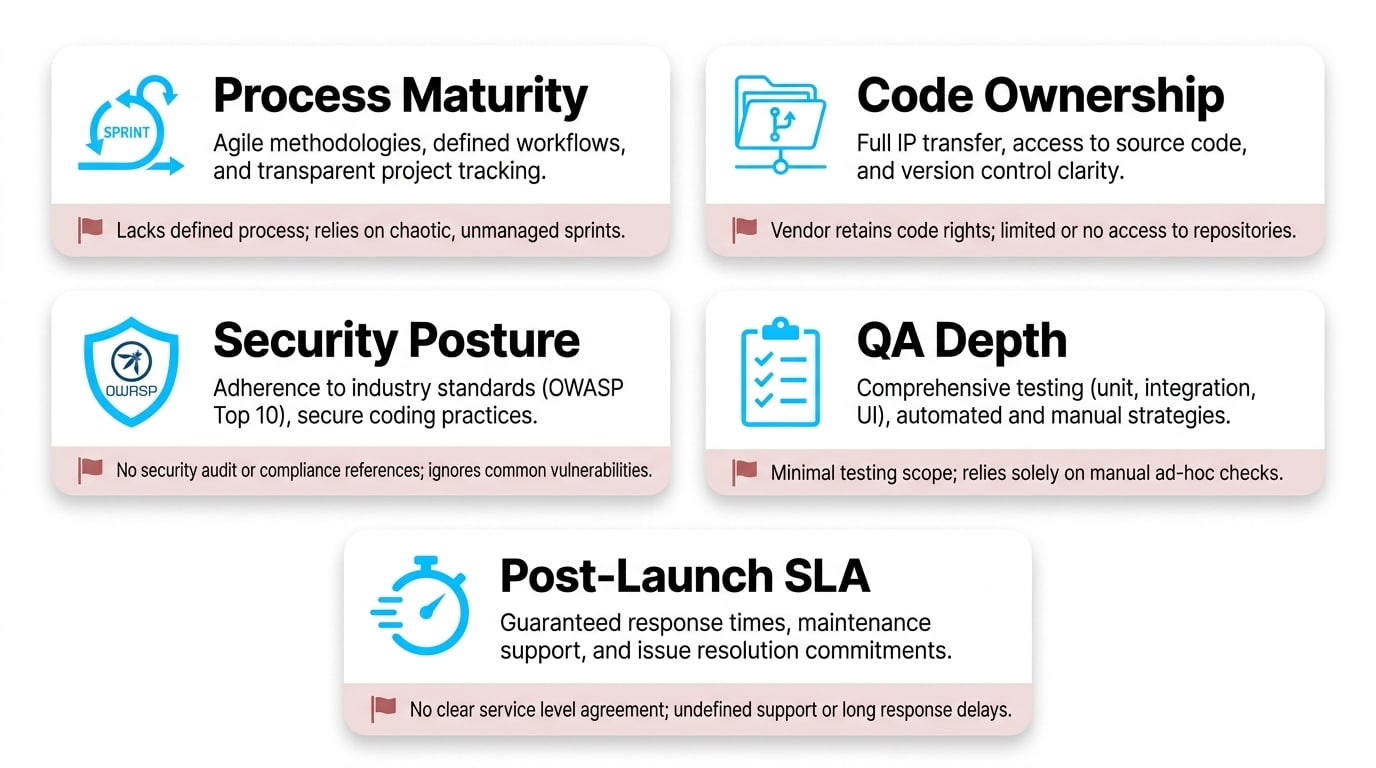
| Criterion | What to look for | Red flag |
|---|---|---|
| Process maturity | Documented sprints, demos, retrospectives | Ad-hoc updates, no delivery cadence |
| Code ownership | Client-owned repos and cloud accounts | Vendor-locked infrastructure |
| Security posture | OWASP MASVS-aligned testing | No mention of security standards |
| QA depth | Functional, performance, and security tests | Manual smoke tests only |
| Post-launch SLA | Defined response times and escalation paths | “Best effort” support with no SLA |
According to DORA research, elite software delivery teams deploy to production multiple times per day with change failure rates below 5%. If a vendor cannot describe their deployment frequency with a specific number, that is a signal worth investigating further before signing.
The mobile application development process from discovery to launch
A healthy process is iterative: discovery defines the problem, design validates the solution, sprint-based development builds it incrementally, and QA verifies each release. Acceptance criteria are written before development starts so that “done” is measurable rather than subjective. This rhythm allows your team to inspect progress every two weeks and adjust priorities based on real feedback rather than assumptions made months earlier.
Discovery and scoping for long-term scalability
Discovery is where future scale is either enabled or quietly broken. Decisions about authentication architecture, data modeling, and multi-tenancy made during the first two weeks determine how easily you will support ten times more users a year from now. Investing the time upfront — with senior engineers in the room alongside product and design — is the single highest-leverage activity in the entire lifecycle.
Iterative development and change management
Change is inevitable in any real product, so the process must accommodate it without chaos. A clear change-request workflow, transparent backlog grooming, and weekly demos keep stakeholders aligned and prevent the delivery surprises that erode trust between teams. A well-run sprint review is worth more than any status report.
How long does mobile app development take?
A focused MVP typically takes 8–16 weeks, while a full enterprise-grade product often runs 4–9 months. Variables that extend timelines include payment integrations, complex permission systems, offline functionality, real-time sync, and high-scale backend requirements. An experienced team with a clean process shortens calendar time more reliably than simply adding more developers — Brooks’s Law remains as relevant as ever, and communication overhead grows quadratically with team size.
The single most effective way to accelerate your first release is to ruthlessly prioritize the features that validate your core hypothesis and defer everything else to the roadmap. A smaller, polished MVP shipped in 10 weeks almost always outperforms a bloated v1 shipped in 7 months.
How is the cost of mobile application development determined?
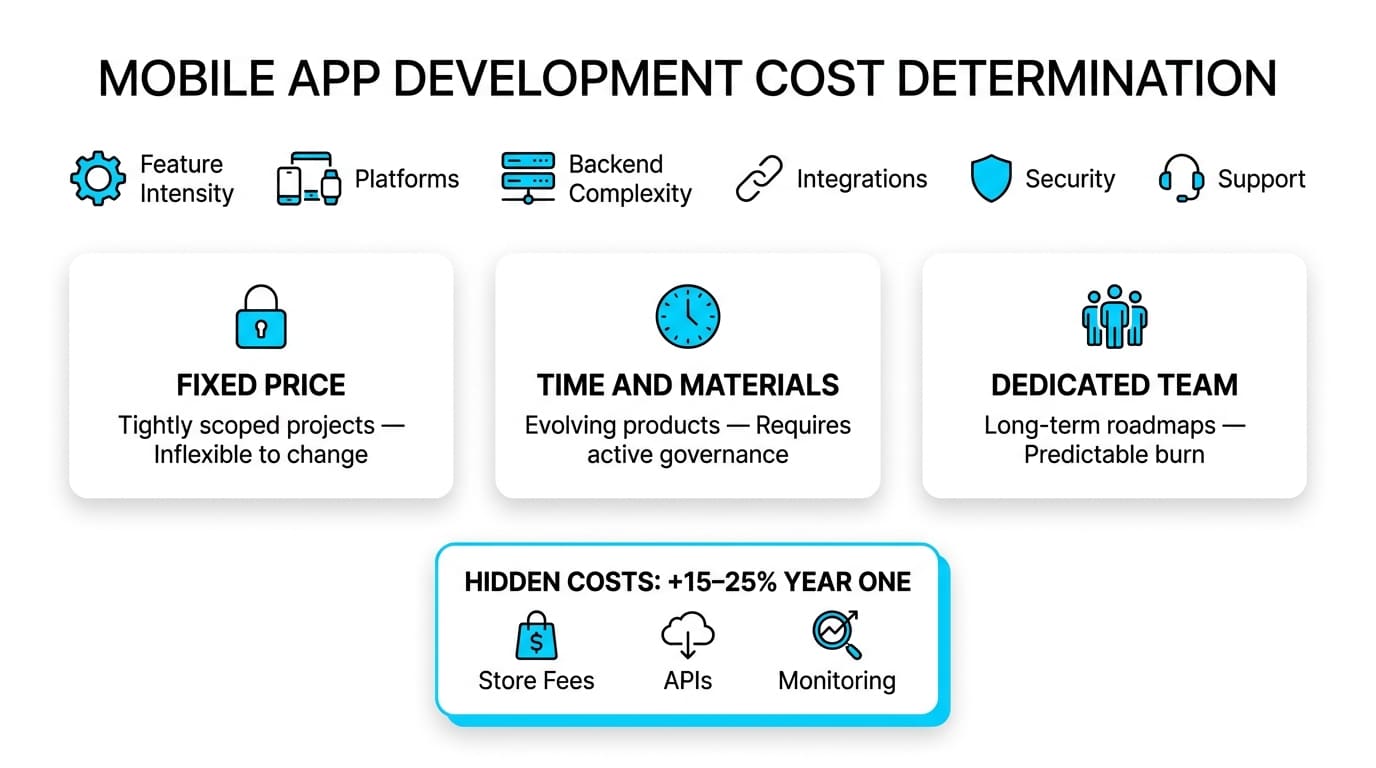
Cost is driven by feature intensity, the number of platforms, backend complexity, integrations, security requirements, and the depth of post-launch support. A precise estimate breaks the product down into screens, user flows, integrations, and roles — PM, UX, Dev, QA, DevOps — then assigns hours to each. Vague proposals based on a single round number are almost always wrong in both directions: they either underprice the work and create adversarial conversations later, or they overprice a scope that was never fully understood.
Comparison of pricing models
| Model | Best for | Trade-off |
|---|---|---|
| Fixed price | Tightly scoped, well-understood projects | Inflexible to change; scope risk falls on vendor |
| Time & Materials | Evolving products with shifting priorities | Requires active client governance to control burn |
| Dedicated team | Long-term roadmaps and continuous scaling | Higher commitment, but predictable monthly burn |
Hidden operational costs to plan for
Beyond development hours, budget for app store fees, third-party API usage costs, push notification services, monitoring and observability tooling, and ongoing maintenance. These frequently add 15–25% to your first-year total cost and are often omitted entirely from initial vendor proposals — leaving teams surprised when the bills arrive in month three.
Should you prioritize iOS, Android, or both?
The answer depends on your audience, not on preferences or assumptions. B2C products with broad geographic reach usually justify both platforms from launch, while focused audiences — a specific region, a niche profession, or a managed corporate device fleet — may warrant starting on one. In B2B environments, device management policy often dictates the choice entirely. Use real data from your existing web traffic analytics and customer interviews rather than guessing; the cost of building for the wrong platform first can set your roadmap back by months.
Native mobile development versus cross-platform solutions
Native development with Swift or Kotlin gives you peak performance, the smoothest animations, and full access to platform-specific capabilities — ARKit, HealthKit, on-device ML, and deep OS integrations. Cross-platform frameworks like React Native and Flutter share the majority of the codebase across iOS and Android, accelerating time to market and reducing ongoing maintenance overhead for products built around standard UI patterns. The right choice is rarely ideological — it is a function of your product’s specific performance profile, integration requirements, and team composition.
How to align the tech stack with your business use case
If your product depends on heavy graphics rendering, real-time sensor data processing, or deep OS integration, lean toward native. If your product is primarily feature-driven — standard forms, lists, content, and standard navigation patterns — cross-platform usually delivers faster ROI and lower maintenance overhead. Document the decision in your architecture decision records so future hires and incoming engineers understand the rationale without needing to reconstruct it from context.
Platform-specific languages giving full API access, best-in-class performance, and the most idiomatic user experience on each OS.
JavaScript-based cross-platform framework with a large ecosystem, shared business logic, and near-native rendering via the new architecture.
Dart-based framework from Google with its own rendering engine, delivering consistent visuals and strong performance across iOS, Android, and web.
What to prepare before starting your project
Arrive at your first scoping session with business goals, a target audience description, a prioritized feature list, examples of competitor or reference apps, and the core user scenarios you want to support. A short “definition of success” document — three to five measurable KPIs — accelerates every product decision that follows. Even rough hand-drawn sketches save hours of clarification during discovery; they communicate intent in ways that words alone rarely do.
Defining what success looks like — activation rate, day-30 retention, transaction conversion, API p95 latency — before a single wireframe is drawn keeps every subsequent decision anchored to outcomes rather than opinions. Teams that do this ship more confidently and iterate more purposefully.
UX/UI design that drives retention and conversion
Strong UX is built on short flows, clear information hierarchy, visual consistency, and continuous measurement after launch. The biggest retention wins typically come from shortening onboarding sequences, reducing form fields to the minimum viable set, and triggering the right action at the right contextual moment. Design is not a phase that ends at launch — it is a continuous discipline that responds to real user behavior, not assumptions made during ideation.
UX metrics in the mobile sales funnel
Track activation rate (users completing a key action within the first session), day-7 and day-30 retention, conversion at each funnel step, and time-to-value for new users. These four metrics together tell you whether your design is working more reliably than any qualitative impression gathered in a focus group or stakeholder review.
Architecting secure and scalable backends and APIs
A reliable mobile app rests on a well-designed backend: clear API contracts documented with OpenAPI or equivalent standards, role-based access control with least-privilege enforcement, rate limiting, aggressive caching, and observability instrumented from day one. Choose architectures that can scale horizontally and deploy them with logging, metrics, and distributed tracing so problems surface in your dashboards before users encounter them in the app.
Best practices for third-party integrations
Wrap external services — payment gateways, identity providers, analytics vendors — behind your own abstraction layer so you can swap providers without rewriting app logic. Validate every incoming webhook payload, monitor partner uptime against your own SLAs, and budget proactively for the inevitable API version migrations that external providers will announce with varying amounts of notice.
Ensuring security and data privacy in mobile applications
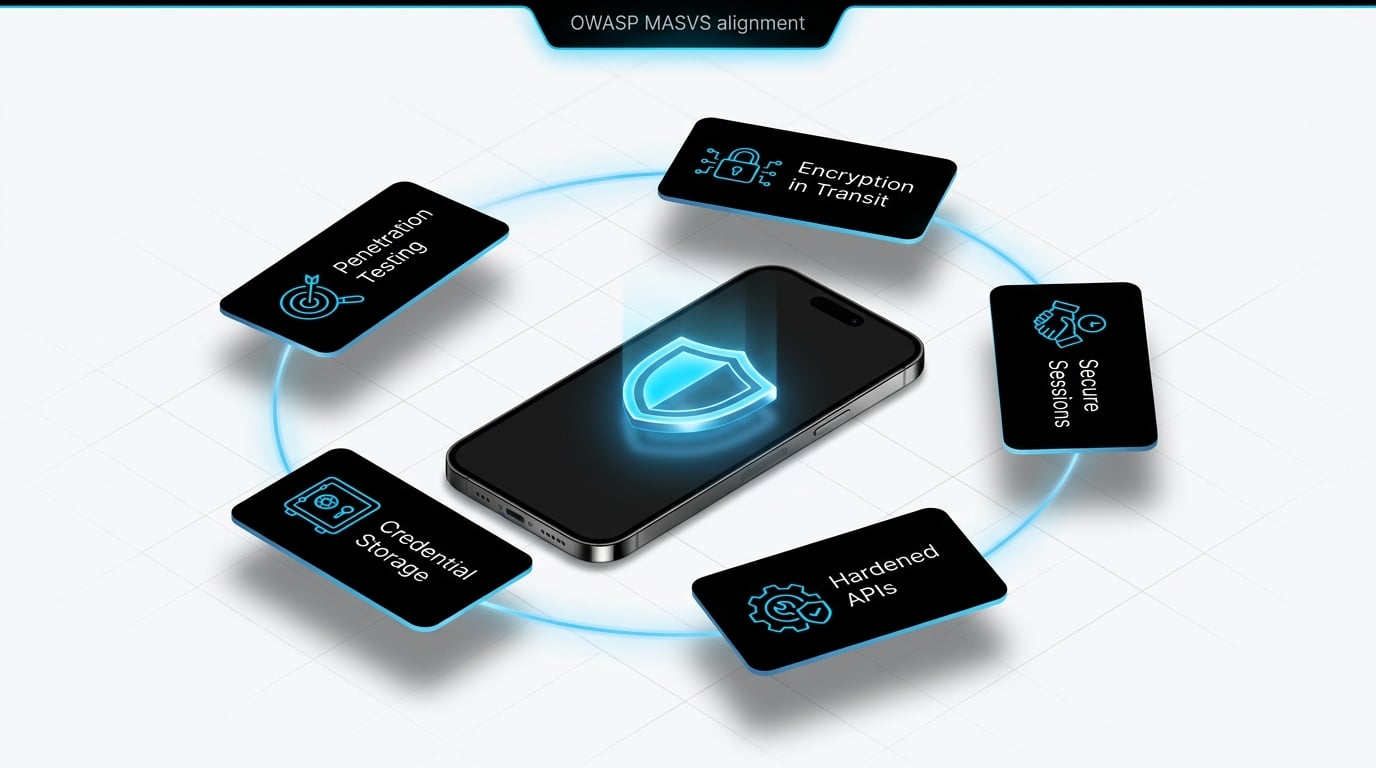
Mobile security is layered: encryption in transit and at rest, secure session management, hardened API endpoints, safe credential storage using platform keychain facilities, and routine penetration testing on a defined schedule. The OWASP Mobile Application Security Verification Standard provides a practical, maturity-leveled benchmark for what “secure” actually means at each stage of your product’s growth — and aligning your QA against it gives you a defensible position with enterprise customers, security reviewers, and external auditors.
Security layers: client-side versus server-side
Treat the client as untrusted by design. Sensitive business logic, authorization decisions, and data validation belong on the server. Client-side protections — certificate pinning, jailbreak and root detection, code obfuscation — raise the cost and complexity of an attack, but they never replace server-side controls. Any security architecture that relies primarily on client-side enforcement will eventually be bypassed.
Common mistakes that create vulnerabilities
The most frequent mobile security issues echo the categories documented in the OWASP Mobile Top 10: insecure data storage, weak or improperly implemented authentication, hardcoded secrets and API keys in the binary, and insufficient transport layer protection. These are predictable, well-documented, and entirely preventable with disciplined code review practices and automated security scanning integrated into your CI pipeline from the very first sprint — not bolted on as an afterthought before submission.
- Hardcoded API keys and secrets in source
- Unencrypted local data storage
- Overly permissive network security configs
- Outdated dependency versions with known CVEs
- Missing certificate validation in test builds
- Broken authorization on API endpoints
- Session token leakage via logs or URLs
- Insecure deep link handling
- Insufficient server-side validation
- Sensitive data exposure in crash reports
The role of QA in reducing technical debt and costs
Quality assurance covers functional testing, device and OS compatibility across a representative device matrix, performance testing under realistic load, security validation, and end-to-end user journey testing that mirrors real usage patterns. Catching defects before release is dramatically cheaper than fixing them after a one-star review, a store rejection, or — in the worst case — a security incident. Treat QA as an investment in delivery velocity, not a cost center to be trimmed when budgets tighten. The teams that cut QA first consistently accumulate the most technical debt and the slowest future delivery cadence.
Post-launch: maintenance, updates, and long-term support
After launch, you need crash monitoring, OS update compatibility testing for every major Apple and Google release, performance tuning, feature additions, and a tiered SLA for incidents. Define bug prioritization levels, target response and resolution times, a staging environment that mirrors production fidelity, and a phased rollout strategy — all from day one, not retrospectively after the first critical bug surfaces. Apps that are not actively maintained degrade quickly, both technically and commercially.
Moving from project development to a growth partnership
The most successful mobile products treat the development partner as an embedded extension of the internal product organization. A predictable quarterly roadmap, shared KPIs reviewed every sprint, and joint retrospectives that surface process improvements turn what began as a vendor relationship into a genuine growth engine. This is the model that Sentice is built around — not project delivery, but continuous, culture-aligned partnership.
How Sentice supports mobile product teams
As a boutique tech partner, Sentice works as a genuine extension of your team — not a body-shop or a distant offshore vendor. Our senior engineers integrate with your existing rituals, standards, and culture from the first sprint. The table below maps the most common business needs of startups and scaleups to the specific ways a Sentice engagement addresses them in practice.
| Business need | How a boutique partnership helps in practice |
|---|---|
| Scaling capacity without losing quality | Embedded senior engineers integrate with your existing rituals, standards, and delivery cadence |
| Predictable delivery | Sprint-based cadence with transparent fortnightly demos and clear, measurable acceptance criteria |
| Long-term ownership | Client-owned code repositories, cloud accounts, and living documentation from day one — no lock-in |
| Security and compliance readiness | QA aligned with mobile security standards and structured, auditable release processes |
| Continuous improvement post-launch | Crash monitoring, analytics, and a quarterly roadmap driven by real user behavior data |
Frequently asked questions
What is the difference between development services and maintenance?
Development services build new functionality and ship it through a structured sprint and release process. Maintenance keeps the existing product healthy: OS compatibility updates, bug fixes, security patches, and minor optimizations. Most mature products run both tracks in parallel — typically with the same team — so that new features and platform stability are managed together under a single prioritized backlog rather than across separate contracts.
How do you decide between a PWA and a native app?
If you need offline-first behavior, reliable push notifications across all platforms, deep hardware integration, or store presence for brand credibility and discoverability, a native or cross-platform app is the right choice. Progressive Web Apps work well for content-heavy experiences with low engagement frequency, where instant loading from a URL and low maintenance overhead matter more than platform-native capabilities. The decision should be driven by user behavior data, not technology preference.
How is feature pricing handled after the project commences?
New features are scoped, estimated, and approved through a documented change-request workflow before any work begins. Under a dedicated team model, prioritization happens transparently within the shared backlog without the need to re-contract for every addition, which keeps velocity high and administrative overhead low. Under a fixed-price model, changes are formally scoped and approved as contract amendments with agreed estimates attached.
What documentation is required to receive an accurate quote?
A brief product description, your target audience profile, a prioritized feature list, integration requirements, non-functional requirements covering security, scale, and compliance, and any existing assets, wireframes, or design files. The more specific and complete the input, the tighter the resulting estimate. Providing nothing more than a concept results in a range too wide to be useful for planning purposes — the scoping investment pays for itself immediately.
How do you measure success post-launch?
Combine product KPIs — activation rate, day-7 and day-30 retention, funnel conversion — with technical KPIs such as crash-free session rate, API p95 latency, and mean time to recover from incidents. Review them together every sprint and use the results to adjust the roadmap. A shared dashboard visible to both your team and your development partner creates the alignment needed to make good prioritization decisions quickly.
How do you work effectively with an offshore or remote development team?
Effective remote collaboration relies on meaningful overlap in working hours, shared tooling, written documentation as the default communication medium, and structured ceremonies — sprint planning, daily standups, demos, and retrospectives — that create predictable rhythm. A genuine technical partnership goes beyond communication mechanics: it means aligned culture, shared accountability for outcomes, and a single roadmap rather than a client-vendor divide where two teams are optimizing for different things.
How do you handle third-party library and dependency risks?
Dependencies are inventoried in a software bill of materials, scanned for known vulnerabilities on every CI run, and updated on a structured cadence rather than ad hoc. License compliance is reviewed during onboarding of each new library. This practice aligns with broader software supply chain security guidance and gives you — and any enterprise customers or auditors — a clear, verifiable picture of what your product is built on.
What does “start small, grow fast” mean in practice for a mobile product?
It means shipping a polished, focused MVP to real users as quickly as the architecture allows — typically 8–12 weeks — and then iterating based on measured behavior rather than assumptions. The team, the codebase, and the infrastructure are all designed for horizontal growth from day one, so adding capacity, features, or platforms later is an engineering task, not a structural renegotiation. This approach consistently produces better products than building the full vision upfront before any user has validated it.

Sentice is a boutique tech partner that builds custom software solutions for startups and scaleups. We embed senior engineers into your product organization as a real extension of your team — culture-aligned, end-to-end, and committed to your roadmap.