
Software Outsourcing Services: The Strategic Guide for Startups and Scaleups
How to scale engineering capacity, accelerate delivery, and protect quality by partnering with the right outsourcing team.
- Software outsourcing is a strategic lever — not a shortcut — enabling faster delivery, specialized expertise, and predictable scale without the burden of full-cycle recruitment.
- Choosing between staff augmentation and fully managed outsourcing depends on how much internal engineering leadership bandwidth your organization already has.
- IT outsourcing and software development outsourcing serve fundamentally different goals; knowing which you need is the first step toward a successful engagement.
- DORA metrics — deployment frequency, lead time, change failure rate, mean time to recovery — are the most reliable benchmarks for measuring outsourced engineering performance.
- Cultural alignment, transparent communication, and a well-defined Definition of Done consistently differentiate high-trust partnerships from vendor relationships that underdeliver.
- A boutique tech partner adapts engagement models to your stage — whether you are an early-stage startup iterating on an MVP or a scaleup managing complex enterprise systems.
Table of Contents
- What are software outsourcing services?
- Why do companies choose software outsourcing services?
- Startup agility versus enterprise scale
- IT outsourcing versus software development outsourcing
- Staff augmentation versus full outsourcing
- What does an effective engagement process look like?
- How do you choose the right IT outsourcing company?
- How do you protect security and IP?
- What KPIs prove your outsourcing engagement is working?
- Common mistakes companies make when outsourcing
- The role of modern engineering standards in outsourced delivery
- Mapping business needs to outsourcing outcomes
- Delivering high-quality products from discovery to deployment
- Frequently asked questions
In today’s fast-moving digital economy, building software at the right pace, with the right quality, and the right talent has become a defining challenge for both startups and scaleups. Hiring senior engineers takes months, internal teams are stretched thin, and product roadmaps keep expanding faster than headcount can follow. This is exactly where software outsourcing services step in — not as a shortcut, but as a strategic lever to scale capacity, accelerate delivery, and bring specialized expertise into your organization. When done right, outsourcing becomes less about delegation and more about partnership: an extension of your team that helps you build better products, faster.
Working with a boutique tech partner like Sentice ensures that this collaboration is culturally and technically aligned with your goals from day one. This guide covers everything you need to evaluate, structure, and measure an outsourcing engagement — from choosing the right model and vetting your partner, to protecting IP and tracking the metrics that actually matter.
What are software outsourcing services?
Software outsourcing services are professional engagements where an external provider takes responsibility for technical projects, product development, or specific engineering cycles on your behalf. This is far more than supplying labor — it is about leveraging an experienced engineering partner to drive innovation across web, mobile, IoT, and cloud-native platforms. When you outsource software development, you gain access to senior engineers, established delivery processes, and modern engineering practices that would otherwise take years to build in-house.
The model can cover end-to-end product development, modernization of legacy systems, QA automation, DevOps, or specialized capabilities such as AI integrations and data engineering — all tailored to your business priorities. The strongest engagements treat the external team not as a vendor, but as a genuine extension of your product organization, bringing both technical depth and delivery accountability to every sprint.
A scoped engagement with defined deliverables, timeline, and fixed or capped cost. Best suited for well-understood initiatives with stable requirements.
An embedded squad that works exclusively on your product, operating within your rituals and tools as a true extension of your internal engineering organization.
Individual engineers integrated into your existing team, managed by your own technical leadership, to fill specific skill or capacity gaps quickly.
Why do companies choose software outsourcing services?
Companies turn to outsourcing because it solves three interconnected problems at once: speed, expertise, and scale. Hiring a full internal team for every initiative is slow and expensive, while market windows close fast. With the right partner, you can spin up dedicated engineering teams that act as a true extension of your internal resources, freeing your core team to focus on strategy, product vision, and customer outcomes.
Outsourcing also reduces the operational burden of recruitment, onboarding, and retention — replacing it with predictable delivery cadence and aligned KPIs. Research consistently shows that engineering attrition is one of the highest-cost events a product organization faces, with ramp-up timelines for senior hires averaging three to six months before full productivity. A well-structured outsourcing engagement eliminates that variable. Ultimately, the goal is to scale faster without compromising engineering quality or cultural fit.
The most successful outsourcing relationships share one trait: the external team is treated as a partner, not a vendor. That means shared context, shared goals, and shared accountability for outcomes — not just hours logged.
Startup agility versus enterprise scale: two sides of the same model
Outsourcing looks different depending on company size — and that is a feature, not a bug. Startups typically need rapid MVP iterations, lean squads, and the flexibility to pivot weekly based on user feedback. For them, a small embedded pod that ships fast is the right answer. The engagement model needs to be lightweight: tight feedback loops, minimal process overhead, and direct access to senior engineers who can make architectural decisions on the fly.
Enterprises, on the other hand, require robust governance, compliance frameworks, and the ability to integrate with complex legacy environments. They need partners who understand SDLC discipline, audit trails, and security baselines. A mature outsourcing partner adapts the engagement model to either reality, balancing speed with structure so the same delivery engine serves both a Series A startup racing to product-market fit and a global enterprise managing hundreds of microservices in production.
- Rapid MVP delivery and iteration cycles
- Lean squad composition, senior engineers only
- Flexibility to pivot scope week to week
- Direct access to decision-makers on both sides
- Low process overhead, high output velocity
- Governance, compliance, and audit trails
- Integration with legacy systems and existing tooling
- Security baselines and access control standards
- Structured SDLC with documented decision records
- Scalable team composition tied to roadmap milestones
The core differences: IT outsourcing versus software development outsourcing

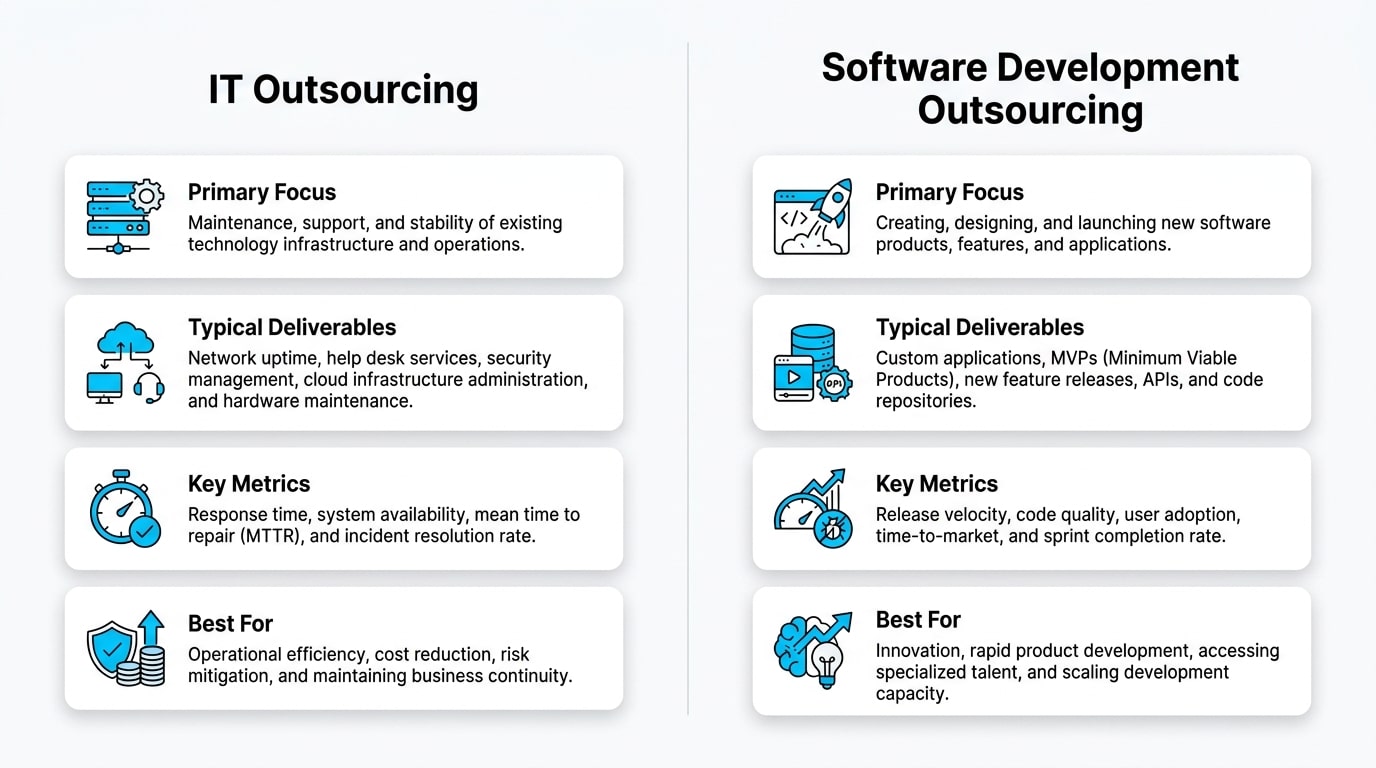
It is easy to confuse these two terms, but they serve fundamentally different goals. IT outsourcing typically covers infrastructure, helpdesk, network management, and day-to-day operations — keeping the lights on and systems stable. Software development outsourcing, by contrast, focuses on the full SDLC: discovery, architecture, coding, QA, deployment, and continuous improvement of digital products. The first is operational; the second is strategic and product-driven.
Knowing which one you actually need is the first step toward building the right partnership and structuring the right contract. Many organizations find that they need both, but from different providers — with the software development partner owning the product roadmap while a separate operations team manages infrastructure reliability.
| Dimension | IT Outsourcing | Software Development Outsourcing |
|---|---|---|
| Primary focus | Operations and support | Product and engineering |
| Typical deliverables | Uptime, ticket resolution, infrastructure | Features, releases, architecture |
| Key metrics | SLA response time, availability | Lead time, deployment frequency, quality |
| Best for | Stable IT environments | Active product roadmaps |
Staff augmentation versus full outsourcing: which model fits you?
Staff augmentation adds individual engineers to your team under your management — ideal when you have strong internal tech leadership and just need extra hands or a specific skill set. Full outsourcing, on the other hand, delegates an entire scope including process ownership, QA, DevOps, and delivery accountability. If you are scoping product development end-to-end, a managed model removes friction: the partner takes responsibility for outcomes, not just hours.
The right choice depends on how much engineering leadership bandwidth you already have and whether you need labor or a complete delivery engine. Organizations with a strong CTO and established processes often benefit from augmentation. Those without that internal capacity — or those tackling a greenfield product — typically get better results from a fully managed team with embedded leadership, defined rituals, and end-to-end delivery ownership.
If you are unsure which model fits your situation, start with a fixed-price discovery engagement. A structured discovery phase surfaces assumptions, de-risks scope, and gives you the information needed to make the right structural decision before any code is written.
What does an effective engagement process look like?
A strong outsourcing engagement is never improvised. It follows a clear, repeatable flow that aligns expectations from day one and keeps quality consistent throughout delivery. Each phase builds on the previous one, creating a foundation of trust and shared context that compounds in value over the life of the engagement.
Discovery and alignment
This stage defines the business problem, scope, risks, assumptions, and success metrics. Discovery outputs typically include an architecture proposal, a prioritized backlog, a risk register, and agreed Definition of Done criteria. Without this foundation, every later decision becomes guesswork — and guesswork in engineering is expensive to unwind.
Onboarding and setup
Repository access, CI/CD pipelines, staging environments, coding standards, and a clear Definition of Done are established so that quality is enforced from the very first commit. The best partners arrive with their own onboarding playbook and adapt it to your environment within the first few days.
Delivery in sprints
Planning, development, testing, demos, retrospectives, and predictable releases — all transparent and measurable. Sprint velocity, deployment frequency, and bug escape rate are tracked continuously, giving you visibility into progress without requiring constant oversight.
Handover and maintenance
Documentation, runbooks, knowledge transfer sessions, and a clear support plan ensure continuity well beyond the active build phase. A professional partner treats handover not as an afterthought but as a first-class deliverable, planned from day one.
How do you choose the right IT outsourcing company?
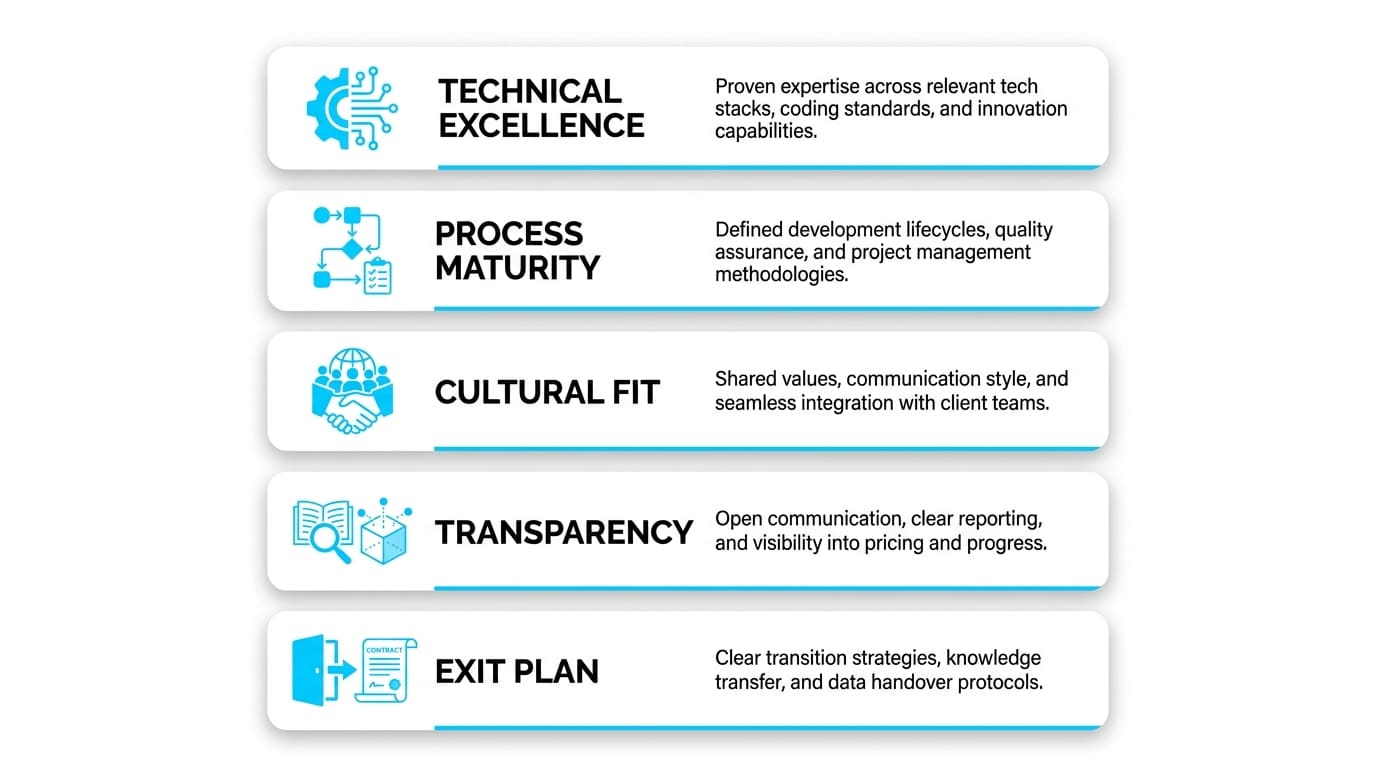
Choosing the right partner is less about price and more about proof. Look at how they vet engineers, how they handle code reviews, what their CI/CD maturity looks like, and whether they can show real case studies with measurable outcomes. Ask about their approach to architecture decisions, technical debt management, and incident response. The answers reveal far more about delivery culture than any proposal document.
Cultural alignment matters just as much as technical excellence. A partner that communicates in your rhythm, adapts to your tools, and genuinely respects your product vision will deliver compounding value over time. One that treats every interaction as a contract negotiation will erode trust in every sprint. Use the framework below as a starting point for your evaluation conversations.
| Vetting Criterion | What to Look For |
|---|---|
| Technical excellence | Senior engineers, modern stacks, code samples, architecture references |
| Process maturity | Defined SDLC, CI/CD pipelines, QA automation, ADR practice |
| Cultural fit | Communication style, time-zone overlap, English fluency, team rituals |
| Transparency | Clear reporting cadence, shared KPIs, sprint visibility, open backlog |
| Exit plan | Documentation standards, knowledge transfer sessions, transition support |
How do you protect security and IP when you outsource software development?
Protecting intellectual property and sensitive data is non-negotiable, and the foundation is contractual. Clear IP assignment clauses, NDAs, and well-defined ownership of source code, libraries, and deliverables must be established before work begins. On top of that, operational controls matter equally: least-privilege access, secrets management, environment separation, mandatory code reviews, SAST/DAST scanning, dependency monitoring, and full audit logging create a security posture that scales with the engagement.
A trusted partner builds these controls into the SDLC by default, not as an afterthought. Security reviews should be part of every sprint definition of done, not a one-off audit at the end of a project. When evaluating a potential partner, ask specifically how they handle credentials, how they manage engineer offboarding, and what their incident response playbook looks like. The maturity of those answers tells you a great deal about the organization’s overall engineering discipline.
Most IP disputes in outsourced development arise not from bad intent, but from ambiguous contracts. A single clear clause specifying that all work product, commits, and deliverables transfer to the client upon payment resolves the vast majority of potential conflicts before they arise.
What KPIs prove that your outsourcing engagement is actually working?
Without measurement, outsourcing becomes a black box. The most reliable benchmarks come from the industry-standard DORA metrics framework, which evaluates engineering performance across four dimensions: deployment frequency, lead time for changes, change failure rate, and mean time to recovery. Elite-performing teams — as defined by DORA research — deploy multiple times per day with lead times under one hour and recover from incidents in under one hour as well.
Combine DORA metrics with product-level KPIs — feature adoption rate, bug escape rate, sprint predictability, and backlog health — and you get a complete, honest picture of whether your partner is delivering real value or simply generating activity. Establish a shared dashboard from the first sprint so that both sides are looking at the same numbers throughout the engagement.
| Metric Category | Metric | What It Tells You |
|---|---|---|
| DORA | Deployment frequency | How often working software reaches production |
| DORA | Lead time for changes | How fast ideas become shipped features |
| DORA | Change failure rate | Percentage of deployments that cause incidents |
| DORA | Mean time to recovery | How quickly the team resolves production issues |
| Product | Bug escape rate | Defects reaching production versus caught in testing |
| Product | Sprint predictability | Ratio of committed to delivered story points per sprint |
Common mistakes companies make when outsourcing software development
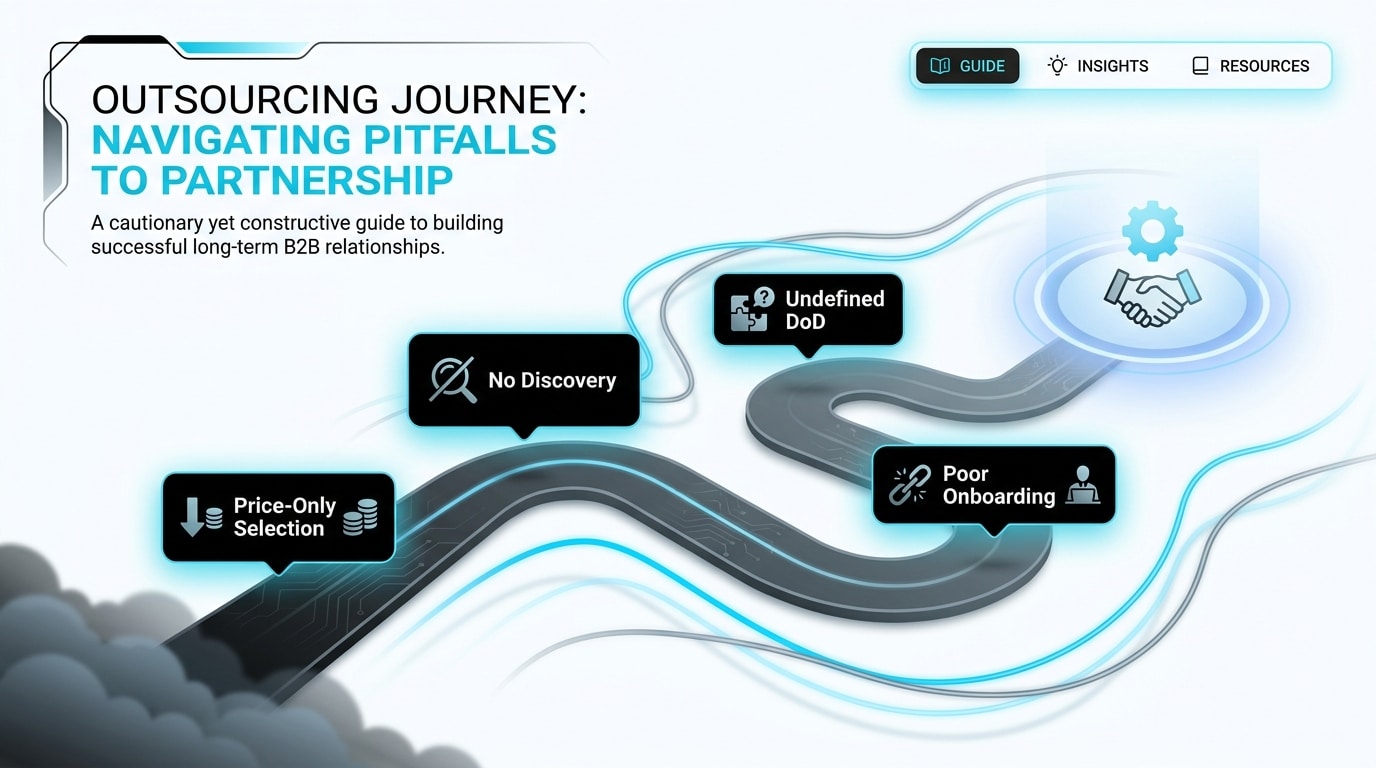
Many engagements fail not because of the partner’s technical ability, but because of how the relationship is structured from the start. The most common pitfalls include choosing a vendor purely on price, skipping the discovery phase, leaving the Definition of Done undefined, ignoring time-zone overlap requirements, and treating the external team as outsiders rather than genuine collaborators. Each of these mistakes is preventable — and each one compounds over time if left unaddressed.
Another frequent mistake is underinvesting in onboarding. Assuming that engineers can be fully productive on day one without deep context about your domain, codebase, and product goals is one of the most reliable ways to slow down early delivery. The best engagements treat the first two weeks as an investment in shared understanding — not a cost to be minimized.
- Selecting a partner on price alone
- Skipping or compressing the discovery phase
- Leaving Definition of Done undefined
- Ignoring time-zone and communication overlap
- Treating the external team as a vendor, not a partner
- Underinvesting in structured onboarding
- Shared backlog with full context and acceptance criteria
- Agreed DORA and product KPIs from sprint one
- Regular retrospectives with genuine action items
- Direct access to senior engineers, not just a PM layer
- Consistent definition of done enforced in every sprint
- Documented architecture decisions and runbooks
The role of modern engineering standards in outsourced delivery
Code quality is not an accident; it is the result of enforced standards. Linting rules, code conventions, architecture decision records (ADRs), automated testing at unit and integration levels, and consistent documentation all create a baseline that scales across teams and time. When a new engineer joins the project — whether internal or external — these standards eliminate ambiguity and compress the ramp-up curve significantly.
A reputable outsourcing partner brings these standards as part of the package and provides transparent reporting so you always know where the codebase stands in terms of test coverage, technical debt, and dependency health. This is one of the primary reasons businesses working with a culture-aligned boutique partner consistently experience fewer production regressions, faster feature cycles, and smoother onboarding for new engineers down the line.
Require architecture decision records (ADRs) for every significant technical choice. ADRs create an institutional memory that survives team changes, sprint retrospectives, and even full partner transitions — making your codebase genuinely durable, not just functional.
Mapping business needs to outsourcing outcomes
To make outsourcing tangible, it helps to map specific business needs directly to what a strong partner delivers in practice. Too many evaluations focus on technology stack or hourly rates when the real conversation should be about outcomes: what changes in your business when the engagement works as intended. The table below shows how typical scaleup challenges translate into concrete results when you work with an embedded, culture-aligned team.
| Business Need | How a Boutique Partner Helps in Practice |
|---|---|
| Accelerate MVP launch | Embedded squad with senior engineers, ready to ship production-quality code within weeks of kickoff |
| Scale capacity predictably | Flexible team composition that grows and contracts in alignment with roadmap milestones and funding stages |
| Maintain engineering quality | Built-in QA automation, CI/CD pipelines, and mandatory code review standards enforced from the first sprint |
| Protect IP and data | Clear IP assignment contracts, least-privilege access controls, and a security-first SDLC by default |
| Stay aligned with internal team | Culture-aligned communication, shared tools, daily overlap hours, and a single embedded point of contact |
Delivering high-quality products from discovery to deployment
The strongest outsourcing engagements treat the full journey — from discovery through deployment and beyond — as one continuous process rather than a sequence of disconnected phases. When the partner owns engineering quality end-to-end, communicates transparently, and stays genuinely aligned with your product vision, development stops being a bottleneck and becomes a competitive advantage.
The goal is not just to ship features on time, but to build durable products that scale reliably with your business. With the right partner acting as a real extension of your team — culture-aligned, senior-led, and committed to your roadmap — that outcome becomes repeatable, not accidental. Building tomorrow’s solutions, together, is not a slogan; it is the operating model that defines what a true boutique tech partnership looks like at its best.
Frequently asked questions
Should we choose Fixed Price or Time and Materials for outsourced development?
Fixed Price works best when scope is stable, well-defined, and unlikely to change during delivery. Time and Materials is better for evolving products, agile iterations, and shifting priorities where requirements are expected to emerge over time. Many successful engagements start with a fixed-price discovery phase to de-risk scope, then transition into Time and Materials for ongoing delivery — capturing the benefits of both models at each stage of the project.
How do we handle time zones effectively with an external engineering team?
Aim for at least three to four hours of daily overlap between your internal team and the outsourced team. Define core collaboration hours clearly — typically for planning, standups, and design reviews — and use asynchronous tools such as written standups, shared dashboards, and recorded demo videos so that progress never depends on a single synchronous meeting. The rhythm, not the geography, determines whether distributed teams succeed.
How important is a dedicated communication channel with the outsourced team?
It is essential. A dedicated Slack or Teams channel, a shared backlog with full acceptance criteria, and a single named point of contact on each side eliminate ambiguity and keep delivery aligned with business goals at all times. When communication is fragmented across email threads and ad hoc calls, context is lost and small misalignments compound into sprint failures. Structure your communication model on day one.
What happens if we need to change outsourcing providers later?
A professional partner plans for handover from the very first sprint: comprehensive documentation, runbooks, clean and well-structured repositories, recorded architectural walkthroughs, and formal knowledge transfer sessions are all part of how a trustworthy engagement ends. If you are evaluating a new partner, ask them directly how their last three engagements concluded — the answer reveals more about operational maturity than any proposal deck.
How fast can an outsourced team become productive after onboarding?
For familiar technology stacks with clear scope and accessible documentation, productive delivery can begin within days to two weeks of kickoff. Enterprises with strict access provisioning, compliance requirements, and multi-system integration complexity typically require a longer onboarding window of three to four weeks before the team reaches full velocity. Investing in a structured onboarding playbook — not treating it as overhead — compresses that timeline significantly.
Can an outsourcing partner take full end-to-end ownership of a product?
Yes. With the right model — typically a dedicated team with embedded engineering leadership — a partner can own discovery, architecture, delivery, QA, DevOps, and ongoing maintenance as a complete, self-contained engineering unit. This works best when the client provides product direction and business context while the partner takes full technical accountability for quality, reliability, and delivery cadence. Sentice operates in exactly this model for several of its long-term clients.
What is the difference between a boutique tech partner and a large outsourcing firm?
A boutique partner works with a deliberately small portfolio of clients, which means your product receives direct senior attention rather than being managed by account layers. Communication is faster, context is deeper, and cultural alignment is treated as a genuine selection criterion rather than a sales talking point. Large firms offer scale and geographic reach; boutique partners offer focus, adaptability, and the kind of long-term technical partnership that compounds in value over multiple product cycles.

Sentice is a boutique tech partner that builds custom software solutions for startups and scaleups. We embed senior engineers into your product organization as a real extension of your team — culture-aligned, end-to-end, and committed to your roadmap.